
CLI tool for building and managing Linux systems on NTL hardware. All builds run in Docker containers; build state persists in named Docker volumes.
| Platform | SoC | Build system | Rootfs |
|---|---|---|---|
| Hive-S | LiteX/VexRiscv RISC-V soft-SoC (Artix-7) | Buildroot | initramfs (cpio) |
| Hive-M | Xilinx ZynqMP | Yocto (bitbake) | squashfs, RAUC A/B |
Documentation
- Command reference - every command, flag, prerequisite
- GUI - pages, what each button runs, settings location
- Project configuration -
project.jsonschema - Hive-S internals - HW/SW/flash build flow
- Hive-M internals - Yocto flow, kernel development
- Update system - RAUC bundles, update archives, signing, legacy migration
- Secure boot - key generation, boot chain, eFUSE provisioning
- UWM apps - app build in the SDK image, update packages, licenses
- Development - repo layout, release process, template update mechanism
Installation
Windows
Run BuildHive_<x.y.z>_Setup.exe from the newest buildhive_v<x.y.z> release. Installs per user, optionally adds buildhive to PATH. Later versions: buildhive upgrade or the update button in the GUI.
Linux (x86_64) / macOS (Apple Silicon)
Extract BuildHive_<x.y.z>_linux-x86_64.tar.gz or BuildHive_<x.y.z>_macos-arm64.tar.gz from the same release and add the buildhive/ directory to PATH. buildhive gui starts the GUI. The macOS build is not signed: after a browser download run xattr -dr com.apple.quarantine buildhive/ once. Later versions: download and extract the new archive, buildhive upgrade --check tells you when one exists.
Requirements
- Docker running (WSL backend on Windows) - required by almost every command
- Vivado on PATH - Hive-S only (
build hw,deploy flash) - VS Code with
codeCLI on PATH - only forbuildhive code - Company SSO account - build secrets (
BUILDSIGN_TOKEN,SSTATE_MIRROR_AUTH) come from the secrets server (secretsinproject.json), browser login on first use; env vars of the same name override - NTL VPN - only for signing update archives
Command names accept unique prefixes: buildhive dep fl = buildhive deploy flash.
Hive-S quickstart
[!IMPORTANT] Requires AMD/Xilinx Vivado in your PATH.
buildhive create -n PROJECT_NAME -t hive-s
cd PROJECT_NAME

buildhive build hw          # generate SoC + IP cores (output: ip/)
# generate bitstream in Vivado, then:
buildhive configure bitstream -f PATH_TO_BITSTREAM   # copies to images/bitstream.bin

buildhive build sw          # UWM + Buildroot (kernel, rootfs, u-boot, opensbi)
buildhive build flash       # assemble images/flash.bin
buildhive deploy flash      # program SPI flash via Vivado/JTAG (device connected)
If multiple devices are connected, you are prompted to select one.
Hive-M quickstart
buildhive create -n PROJECT_NAME -t hive-m
cd PROJECT_NAME

# optional: replace hardware description
buildhive configure xsa -f PATH_TO_XSA          # extracts .bit from XSA
buildhive configure bitstream -f PATH_TO_BIT    # or supply .bit directly
buildhive configure dts -f PATH_TO_DTSI         # custom device tree include

# optional: kernel / u-boot menuconfig
buildhive configure linux
buildhive configure uboot

buildhive build sw          # bitbake aionyx-image-minimal -> images/sd.wic
buildhive build update      # update archive + RAUC bundle, signed -> images/
Kernel development (Hive-M)
Fast out-of-tree module and kernel builds without full bitbake runs:
buildhive build kernel-devsrc        # export kernel source + toolchain to Docker volume (once)

buildhive build module ntl_tsu       # build one NTL driver out-of-tree -> oot/ntl_tsu/*.ko
buildhive build module ntl_tsu --clean

buildhive build kernel-oot           # rebuild kernel Image without bitbake -> images/Image
buildhive build kernel-oot --clean

buildhive shell                      # interactive shell in build container
buildhive shell --module ntl_tsu     # shell with kernel env, cd oot/ntl_tsu

buildhive code                       # VS Code attached to dev container
buildhive code --stop
Dev container mounts: /kernel-devsrc (kernel source + build tree, case-sensitive volume), /oot (host oot/), /drivers (host sources/drivers/).
Command reference
Commands are resolved against the project in the current working directory (project.json, not searched upward). Without a project, only the common commands exist, plus the app commands when buildhive-app.json is present (apps.md). With one, the template field selects the Hive-S or Hive-M command set.
Any command segment may be abbreviated to a unique prefix (buildhive dep fl = buildhive deploy flash). Exact matches win over prefixes; ambiguous prefixes error.
Overview
| Command | hive-s | hive-m | Docker | Other prerequisites |
|---|---|---|---|---|
create | ✓ | ✓ | ✓ | - |
releases | ✓ | ✓ | - | - |
gui | ✓ | ✓ | - | - |
upgrade | ✓ | ✓ | - | secrets server login (GitHub token), Windows for the install |
login / logout | ✓ | ✓ | - | project with secrets (login only), browser |
info project | ✓ | ✓ | - | project |
info secrets | ✓ | ✓ | - | project |
info flash | ✓ | - | - | project, built .fbi files |
configure project | ✓ | ✓ | - | project |
configure linux | ✓ | ✓ | ✓ | interactive terminal |
configure buildroot | ✓ | - | ✓ | interactive terminal |
configure uboot | - | ✓ | ✓ | interactive terminal |
configure bitstream | ✓ | ✓ | - | .bit file |
configure xsa | - | ✓ | - | .xsa file |
configure dts | - | ✓ | - | .dtsi file |
build sw | ✓ | ✓ | ✓ | git access |
build hw | ✓ | - | ✓ | Vivado on PATH |
build flash | ✓ | - | - | images/bitstream.bin + built components |
build kernel | - | ✓ | ✓ | - |
build kernel-devsrc | - | ✓ | ✓ | - |
build kernel-oot | - | ✓ | ✓ | build kernel-devsrc first |
build module <name> | - | ✓ | ✓ | build kernel-devsrc first, drivers repo cloned |
build update | - | ✓ | ✓ | signing: buildsign config, BUILDSIGN_TOKEN, NTL VPN |
export sw | - | ✓ | ✓ | - |
packages list / add / remove | - | ✓ | - | project |
packages index | - | ✓ | ✓ | - |
packages search | - | ✓ | - | packages index first |
secure-boot keygen | - | ✓ | - | - |
secure-boot ppk-hash | - | ✓ | ✓ | keygen + prior build sw |
code | - | ✓ | ✓ | code CLI on PATH |
shell | - | ✓ | ✓ | interactive terminal |
deploy flash | ✓ | - | - | Vivado on PATH, connected device |
clean | ✓ | ✓ | ✓ | - |
App repos (buildhive-app.json in the current directory, no project.json):
| Command | Docker | Other prerequisites |
|---|---|---|
app init | - | none, works in any directory |
app build | ✓ | SDK image (pulled from ghcr.io), VPN for signing |
app sign | - | package in out/, VPN |
app license | - | license in the config, VPN |
Common commands
buildhive create
| Flag | Required | Description |
|---|---|---|
-n, --name | yes | Project name. Letters, digits, -, _; max 128 chars. |
-t, --template | yes | hive-s or hive-m. |
-r, --release | no | Template release, e.g. ntl-v2026.1. Default: newest shipped. |
Creates ./<name>/: copies the default template, then <template>/<release>, writes project.json (release, version from the template), hash manifest (.buildhive_manifest.json) and merge baseline (.buildhive_baseline/). Fails if the directory already contains a project.
buildhive releases
Lists the template releases shipped with this BuildHive per template, newest marked. No project needed.
buildhive gui
Launches the desktop GUI (PySide6); running the exe without arguments does the same. Pages, button-to-command mapping and settings location: gui.md.
buildhive login / buildhive logout
login: OIDC login to the secrets server from secrets.url in project.json or buildhive-app.json (see configuration.md). Opens the browser (company SSO), waits for the callback on http://localhost:8250/oidc/callback, caches the OpenBao token in the OS config dir (token.json, plain text, next to gui.json). Builds log in on demand when a secret is needed and no valid token is cached, so an explicit login is only needed to switch users. logout: deletes the cached token. BAO_TOKEN env (CI machine token) bypasses both.
buildhive upgrade
| Flag | Description |
|---|---|
--check | Only report installed vs. latest version. |
--silent | Installer without the wizard (Inno Setup /SILENT). |
Looks up the newest buildhive_v<x.y.z> release in NetTimeLogic/Tools (draft and pre-release skipped). The repo is private: the GitHub token comes from GITHUB_TOKEN env or the secrets server (buildhive/github, key GITHUB_TOKEN; browser login if no token is cached, no project needed). Newer release: downloads BuildHive_<x.y.z>_Setup.exe to the temp dir and starts it two seconds after the CLI exits, so the installer can replace bin/. The installer removes the old version and installs per user, no admin. Up to date: OK: BuildHive x.y.z is up to date. Linux/macOS: prints the releases page. Exit 1 on token, network or download errors. The GUI has the same check at start plus an update button, see gui.md.
buildhive info secrets
Prints the secrets server, the logged-in email and, per secret (SSTATE_MIRROR_AUTH, BUILDSIGN_TOKEN), the source a build would use: environment variable, <mount>/users/<email>/<secret>, <mount>/<secret> or not available (<reason>). Never prints values, never opens the browser.
buildhive info project
Prints name, ID, template, release, firmware version, BuildHive version. Hive-S: Buildroot repo/branch. Hive-M: Yocto manifest repo/branch and additional clone repos.
buildhive configure project
| Flag | Description |
|---|---|
-n, --name | Rename the project. |
--version <x.y.z> | Firmware version, must start with the release number (ntl-v2026.1 → 2026.1.N). Carried by update archives (HIVE_VERSION), default SDK tag. |
--release <id> | Bind the project to another shipped release (buildhive releases). Resets version to the template's, logs the template branches; the next command runs the template update. sw.* branches in project.json are never merged, adjust them by hand. |
buildhive app ...
app init, app build, app sign, app license: see apps.md.
Hive-S commands
buildhive build hw
| Flag | Description |
|---|---|
-d, --debug | Append hw.debug_args (RISC-V JTAG debug). |
-v, --verbose | Show container output. |
Generates the LiteX/VexRiscv SoC in the HW container (make.py <hw.args>), rewrites the generated Vivado tcl to host paths, runs vivado -mode batch to build IP, copies the IP repo to ip/.
buildhive build sw
| Flag | Description |
|---|---|
--rebuild | Wipe work volumes, build from scratch. |
-v, --verbose | Show container output. |
Clones and builds UWM (out/hive-s_full_tls → images/uwm.xz, uwm-loader into the rootfs overlay), then Buildroot (ntl_defconfig) → kernel Image.lzma, rootfs.cpio.xz, u-boot.bin, opensbi.bin in images/.
buildhive build flash
| Flag | Description |
|---|---|
-v, --verbose | Also print the flash info table. |
No Docker. Wraps each flash mapping entry with a length+CRC32 header (.fbi), builds mapping_table.bin, assembles images/flash.bin (bitstream at offset 0, components at their src offsets, mapping table at 0x3F0000). See hive-s.md.
buildhive info flash
Prints the flash mapping table and image structure (offsets/sizes from .fbi files in images/).
buildhive configure linux / configure buildroot
Interactive make linux-menuconfig / make menuconfig inside the SW container.
buildhive configure bitstream
| Flag | Required | Description |
|---|---|---|
-f, --file | yes | Bitstream file, copied to images/bitstream.bin. |
buildhive deploy flash
Runs vivado -mode gui -source tools/flash_device.tcl to program the SPI flash over JTAG. Requires Vivado on PATH and a connected device.
buildhive clean
Removes and recreates the HW and SW Docker volumes. Fails if a container is using them.
Hive-M commands
All container-based Hive-M commands run src/scripts/hive-m/init.sh first: repo init (first run) and repo sync of the Yocto manifests, source edf-init-build-env, layer sync, machine generation from the SDT, copy of sw/meta-ntl-hive into the build tree, secure-boot and sstate-mirror config. --no-update skips both the repo sync and the pull of the sw.clone repos. local.conf and bblayers.conf are rewritten only when their content changes, so bitbake's parse cache stays valid. See hive-m.md.
buildhive build sw
| Flag | Description |
|---|---|
--rebuild | Wipe SW volume first. |
--no-update | Skip repo sync and the git pull of cloned repos. |
-v, --verbose | Show container output. |
bitbake aionyx-image-minimal → images/sd.wic.
buildhive build kernel
| Flag | Description |
|---|---|
--rebuild | bitbake virtual/kernel -c cleansstate first. |
-v, --verbose | Show container output. |
bitbake virtual/kernel → images/Image.
buildhive build kernel-devsrc
Builds virtual/kernel, resolves source/build paths via bitbake -e, copies kernel source, build artifacts and .config into the case-sensitive kdevsrc Docker volume, writes env.sh (ARCH, CROSS_COMPILE, toolchain PATH). Prerequisite for kernel-oot, module, shell --module, code.
buildhive build kernel-oot
| Flag | Description |
|---|---|
--clean | make clean instead of build. |
Rebuilds the kernel Image directly from /kernel-devsrc (make -j Image modules), no bitbake → images/Image.
buildhive build module <name>
| Flag | Description |
|---|---|
name (positional) | Driver under sources/drivers/staging/ntl/<name>/. C identifier, max 64 chars. |
--clean | Clean before build. |
Scaffolds oot/<name>/Makefile if absent, cross-compiles the module against /kernel-devsrc → oot/<name>/*.ko.
buildhive build update
| Flag | Default | Description |
|---|---|---|
--legacy-migration | off | Build hive-m-migration-*.tar.gz (0.3.9 upgrade path) instead. Unsigned. |
--include <csv> | all | Components: raucb,kernel,dtb,bootscr,bootbin,fitimage,bitstream,dtbo. |
--select | off | Interactive component picker. |
--bitstream <file> | - | PL bitstream (.bit/.bin) for uwm import via /data/firmware/import. |
--dtbo <file> | - | DT overlay (.dtso compiled with dtc, .dtbo as-is); requires --bitstream. |
--no-sign | off | Skip remote signing (archive not installable by uwm). |
--sign-only | off | Sign the newest existing images/hive-m-update-*.tar.gz, no build. |
--version <x.y.z> | project.json version | Firmware version of this archive (HIVE_VERSION), must belong to the project's release. |
--sign-timeout <s> | 3600 | Poll timeout for the signing server. |
--no-update | off | Skip repo sync and repo pulls. |
-v, --verbose | off | Show container output. |
Selecting the bitstream/dtbo component (via --include/--select) without the matching flag opens a file-picker dialog instead; conversely, a given flag adds its component to the selection automatically.
bitbake update-archive → images/update.raucb + images/hive-m-update-<version>.tar.gz, then remote-signs the archive → images/signed_hive-m-update-<version>.bin. See updates.md.
buildhive export sw
bitbake aionyx-image-minimal -c populate_sdk - builds the cross SDK and copies the installer (*.sh) plus Image to images/.
| Flag | Default | Description |
|---|---|---|
--image | off | Build the SDK Docker image from the installer (sdk/Dockerfile). Tags <tag>:<version> and <tag>:latest. |
--push | off | docker push both tags. Implies --image. Needs docker login ghcr.io. |
--tag | ghcr.io/nettimelogic/hive-m-sdk | Image repository. |
--version | project.json version | Image version tag, also written to the org.opencontainers.image.version label. Default keeps SDK and firmware paired. |
--no-build | off | Skip populate_sdk, use the newest *.sh in images/. |
See hive-m.md for the image layout and usage.
buildhive configure xsa
| Flag | Required | Description |
|---|---|---|
-f, --file | yes | .xsa file. Extracts the .bit, validates the header, copies it to sources/sdt/AionyxBaseTop.bit. |
buildhive configure bitstream
| Flag | Required | Description |
|---|---|---|
-f, --file | yes | .bit file. Validates the header, copies it to sources/sdt/AionyxBaseTop.bit. |
buildhive configure dts
| Flag | Required | Description |
|---|---|---|
-f, --file | yes | DTS include, copied to sw/meta-ntl-hive/recipes-bsp/device-tree/files/ntl-custom.dtsi. |
buildhive configure linux / configure uboot
Interactive bitbake virtual/kernel|virtual/bootloader -c menuconfig; the resulting diffconfig fragment is saved as a timestamped user_*.cfg in meta-ntl-hive so it persists across builds.
buildhive packages list / add <name>... / remove <name>...
Edit IMAGE_INSTALL:append in sw/meta-ntl-hive/conf/layer.conf. Names: lowercase letters, digits, + . _ -. The block is rewritten in the template layout, the rest of the file is untouched, so info project updates still 3-way merge it. Applied on the next build sw.
buildhive packages index
| Flag | Description |
|---|---|
-v, --verbose | Show container output. |
Scans every .bb under /work/sources in the SW container (name, layer, SUMMARY, DESCRIPTION, SECTION, RDEPENDS, fields also taken from required .inc files) and writes build/recipe-index.json. Host-only recipes are skipped: *-native, *-cross*, nativesdk-* and anything inheriting native, nativesdk, cross, crosssdk, cross-canadian, image, core-image. Re-run after changing the Yocto manifest.
buildhive packages search [term]
| Flag | Description |
|---|---|
-n, --limit | Maximum results (default 30). |
-g, --packagegroups | Only packagegroup-* recipes. Without a term lists them all. |
-l, --layer | Only recipes from this layer, e.g. poky. Without a term lists the layer. |
Case-insensitive search over the index, ranked: exact name, term as a whole word in RDEPENDS (gcc lists packagegroup-core-buildessential right after gcc), name prefix, whole word in summary/description, substrings. Lists recipes, not split runtime packages. The GUI Configure page has the same list/search under "Image packages".
buildhive secure-boot keygen
| Flag | Description |
|---|---|
--force | Overwrite existing keys. Fused devices keyed to the old PSK become unbootable. |
Generates keys/ (gitignored): psk.pem, ssk.pem (RSA-4096, BOOT.bin auth), fit.key/fit.crt (RSA-2048, FIT signing). See secure-boot.md.
buildhive secure-boot ppk-hash
Runs bootgen -efuseppkbits against the deployed FSBL → images/ppk0_hash.txt for eFUSE provisioning. Requires keys and a prior build sw.
buildhive shell
| Flag | Description |
|---|---|
--module <name> | Source /kernel-devsrc/env.sh, cd oot/<name> (must exist). |
--no-update | Skip repo sync and repo pulls. |
-v, --verbose | Show container output. |
Interactive bash in the SW container with the Yocto environment sourced.
buildhive code
| Flag | Description |
|---|---|
--stop | Stop and remove the background dev container. |
Starts a detached dev container (/kernel-devsrc, oot/, sources/drivers/ mounted) and attaches VS Code to it. Requires the code CLI on PATH.
buildhive clean
| Flag | Description |
|---|---|
-a, --all | Also remove the shared ntl_buildhive_sstate volume (Yocto sstate + downloads). |
Removes and recreates the project SW volume.
GUI
PySide6 desktop front end for the CLI. Same features as the command line except the interactive targets (configure linux|uboot|buildroot, shell, code), plus recipe search and in-place project updates.
Starting
| How | Notes |
|---|---|
Start menu BuildHive | Runs buildhive-gui.exe, no console window. Installed by BuildHive_Setup.exe. |
buildhive gui | From any terminal. |
buildhive.exe without arguments | Same as buildhive gui, keeps the console window. |
python src/main.py | Development checkout, commands run through main.py instead of buildhive.exe. |
The most recently opened project opens at start. Docker Desktop is needed for builds, indexing and create, not for opening the GUI, editing packages or updating a project.
Window
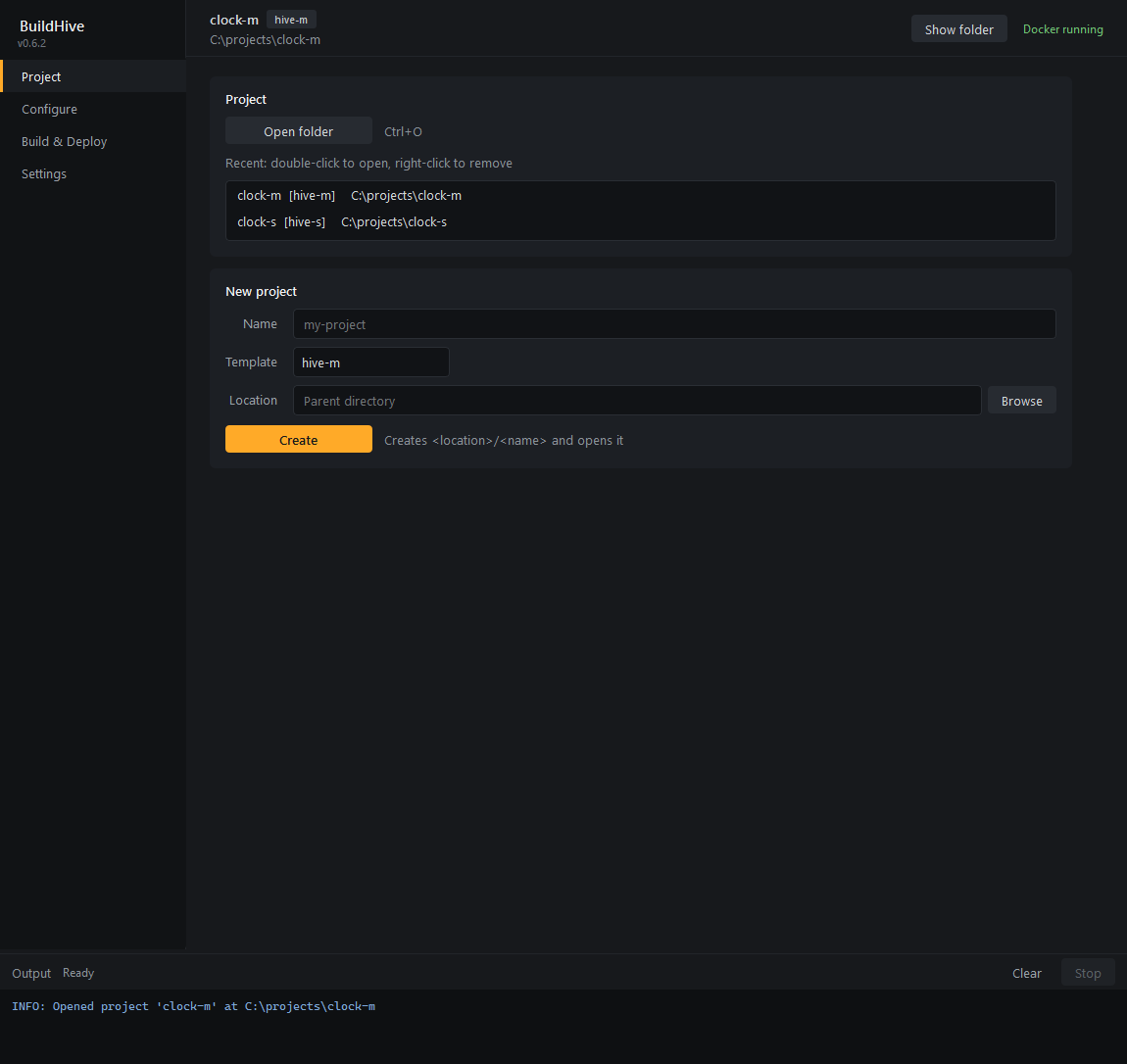
| Area | Content |
|---|---|
| Sidebar | Pages: Project, Configure, Build & Deploy, Settings, About at the bottom. Tool version under the name. Update to x.y.z appears when a newer release exists, see BuildHive updates. |
| Header | Project name, template tag, release and firmware version tag (ntl-v2026.1 · 2026.1.0), path. Show folder opens the project directory in the file manager. Right: Docker daemon state, checked at start and every 10 s. Docker not running means every command that needs Docker fails until Docker Desktop is up; the GUI keeps working. |
| Page | Cards per topic. Each card names what it does under its title. |
| Output | Log of the running command, see below. The splitter above it is draggable; pages scroll, so the console can take most of the window. |
Output panel
Every button that runs a command spawns buildhive <command> in the project directory and streams its output line by line into the panel. The line $ buildhive ... marks the start.
| Element | Behavior |
|---|---|
| Header text | Command and elapsed time while running, then Done (m:ss) or Failed, exit N. During a bitbake run also the first running task (linux-xlnx do_compile 45%) and how many more run. |
| Progress bar | Bitbake tasks done / total, tooltip lists every running task. Fed by the buildhive bitbake UI (src/scripts/bitbake_ui.py, installed into the checkout by the init script and selected with BITBAKE_UI=buildhive; it prints knotty's log plus @@BH {json} state lines the GUI parses) and, as fallback, knotty's Running task N of M (...) lines. Hidden when the command is done. |
| Search | Ctrl+F focuses the field. All matches are highlighted with a count; Enter / F3 jumps to the next, Shift+Enter / Shift+F3 to the previous, wrapping at the ends. Jumping pauses Follow. |
| Follow | Checked: the newest line stays in view. Scrolling up unchecks it, scrolling back to the end checks it again. |
| Clear | Empties the log. |
| Stop | Terminates the command and runs docker stop on the project's containers. Enabled only while a command runs. |
| Colors | $ orange, ERROR: red, WARNING: yellow, OK: green, INFO: blue, rest grey. ANSI codes are stripped. |
One command at a time. While one runs, the Project, Configure and Build & Deploy pages are disabled; Settings stays usable. Closing the window stops a running command first.
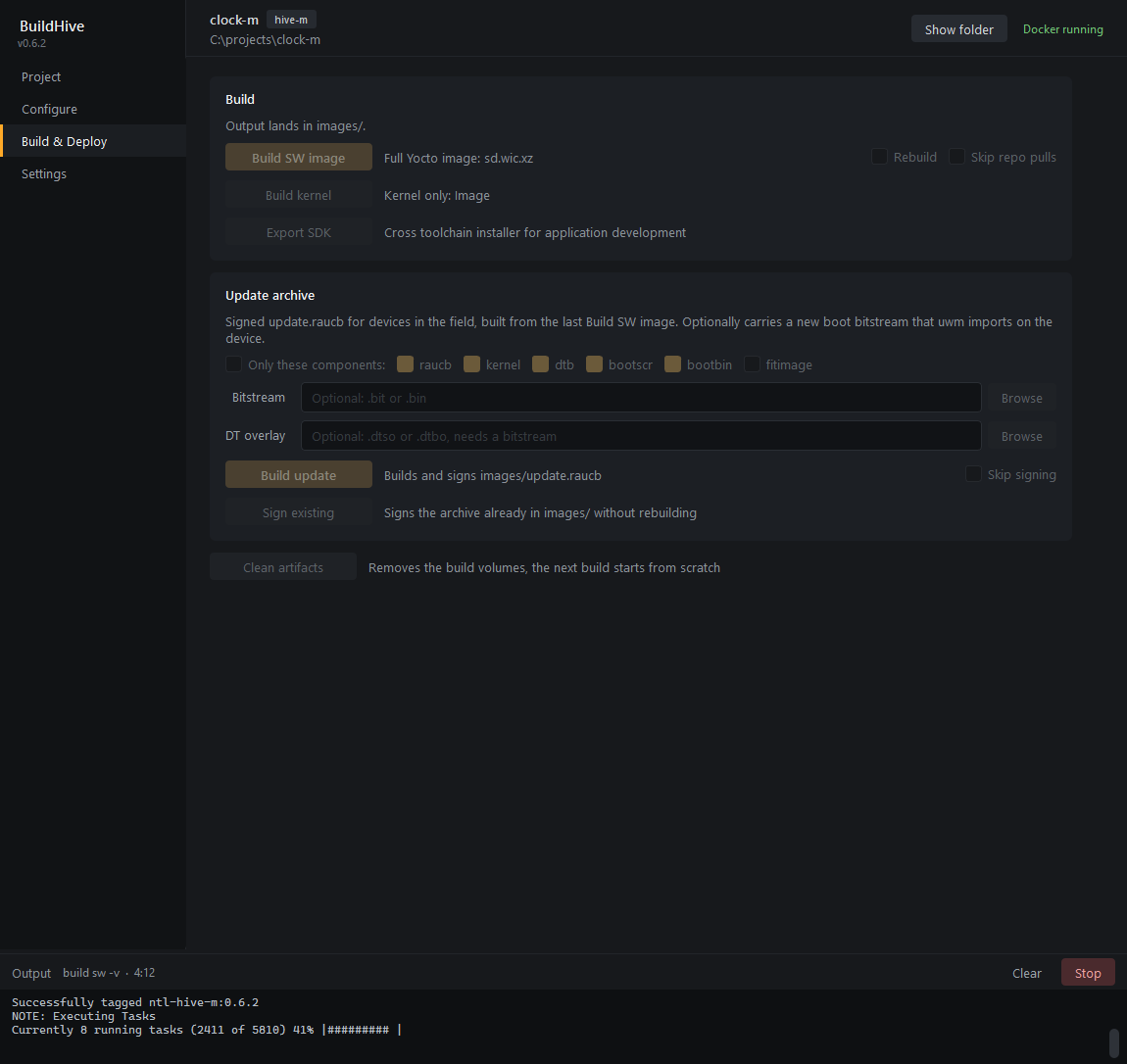
Project
| Item | Action |
|---|---|
| Open folder | Directory picker. The directory needs a project.json, or a buildhive-app.json for a uwm app repo. With neither, the GUI offers app init in that directory. Ctrl+O works on every page. |
| Recent | Last 10 opened projects, newest first. Double-click opens, right-click removes the entry. Missing directories are dropped. |
| New project | buildhive create -n <name> -t <template> -r <release> in the chosen parent directory, then opens the new project. Templates: hive-m, hive-s; the Release list shows the shipped template releases of the template, newest first. |
Project update
Opening a project whose template files (its release under src/templates/) changed since the last sync opens a dialog. A tool release without template changes opens nothing. Cancel keeps the project closed. Yes runs the template update in the GUI (no terminal), the same merge the CLI does on the next command in the project directory.
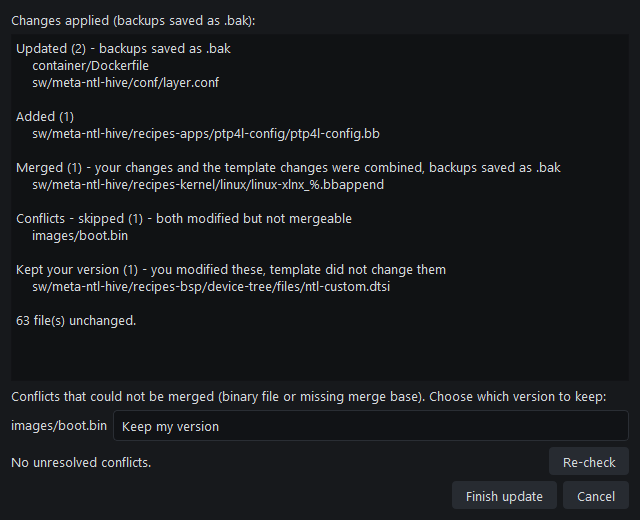
| Section | Meaning |
|---|---|
| Updated | Template file changed, yours did not. Overwritten, backup as .bak. |
| Added | New template file. |
| Merged | Both changed, 3-way merged against the stored baseline. Backup as .bak. |
| Merged with conflicts | Both changed the same lines. The file contains <<<<<<< markers. |
| Conflicts - skipped | Both changed, not mergeable (binary or no merge base). Per-file choice in the dialog: keep my version or take the template version. |
| Kept your version | You changed it, the template did not. |
| Removed | Dropped from the template, you had not changed it. |
| Removed from template | Dropped from the template but you changed it. Moved to .bak so the build no longer uses it. |
Finish update is enabled once no file contains merge markers. Resolve the markers in an editor, then Re-check. Finish writes the manifest, stamps the tool version into project.json and adds sections newer templates need. Cancel after a merge leaves the merged files in place, the manifest keeps the old hashes and the dialog appears again on the next open.
A project created by a newer BuildHive than the installed one is refused with a message to update BuildHive.
Configure
Release and version (both templates). Release: the template line the project is bound to, read-only here (configure project --release on the CLI). Version: firmware build x.y.z, Apply runs configure project --version <value> and reopens the project so the header tag follows.
hive-m
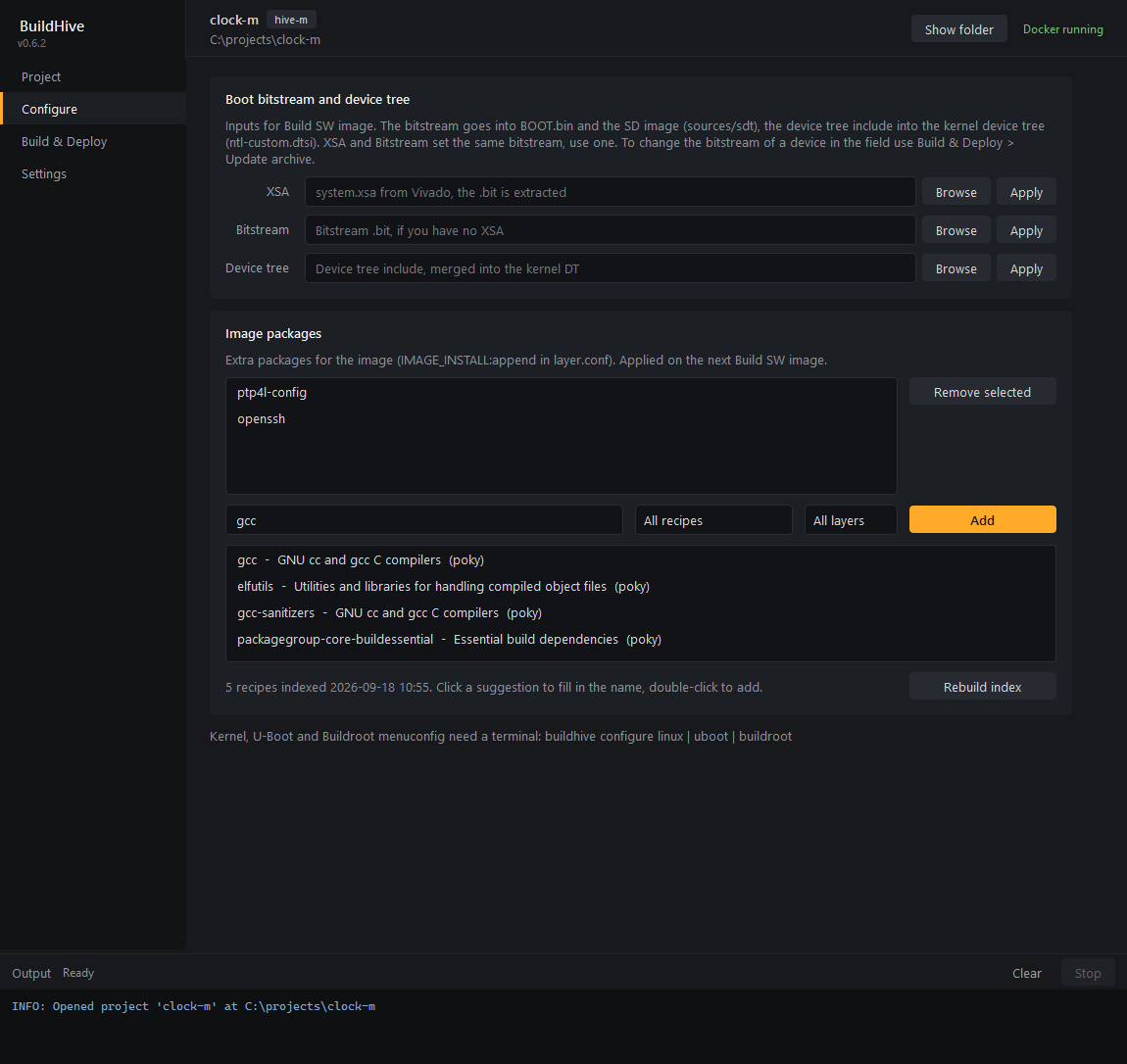
Boot bitstream and device tree. Inputs for Build SW image. The bitstream ends up in BOOT.bin and the SD image, so this is what a device boots from the card.
| Row | Command | Effect |
|---|---|---|
| XSA | configure xsa -f <file> | Extracts the .bit from the Vivado archive to sources/sdt/AionyxBaseTop.bit, header validated. |
| Bitstream | configure bitstream -f <file> | Copies a .bit to sources/sdt/AionyxBaseTop.bit. Same target as XSA, use one of the two. |
| Device tree | configure dts -f <file> | Copies the include to sw/meta-ntl-hive/recipes-bsp/device-tree/files/ntl-custom.dtsi, merged into the kernel device tree. |
Browse fills the field, Apply runs the command. For a device already in the field use the Update archive on Build & Deploy instead, which imports the bitstream at runtime.
Image packages. Edits IMAGE_INSTALL:append in sw/meta-ntl-hive/conf/layer.conf directly, no command. Applied on the next Build SW image. Same file as buildhive packages, see commands.md.
| Element | Behavior |
|---|---|
| Installed list | Current entries. Select one or more, Remove selected. |
| Add field | Package name, Add or Enter. Allowed: lowercase letters, digits, + . _ -. Several names separated by spaces. |
| Filters | All recipes / Packagegroups only, and All layers / one layer. With filters set and an empty field the list shows everything matching. |
| Suggestions | Filtered while typing. Ranking: exact name, recipes whose runtime dependencies contain the term (that is how gcc finds packagegroup-core-buildessential), name prefix, summary, substrings. Click fills the field, double-click adds. Hover shows the recipe description. |
| Build index / Rebuild index | Runs buildhive packages index in the build container and writes build/recipe-index.json. The hint line shows how many recipes are indexed and when. Rebuild after changing the Yocto manifest. |
The index lists recipes, not the split runtime packages a recipe produces (gcc is listed, gcc-symlinks is not). Host-only recipes (-native, -cross, nativesdk-, images) are excluded.
Kernel, U-Boot and Buildroot menuconfig are terminal-only: buildhive configure linux | uboot | buildroot.
hive-s
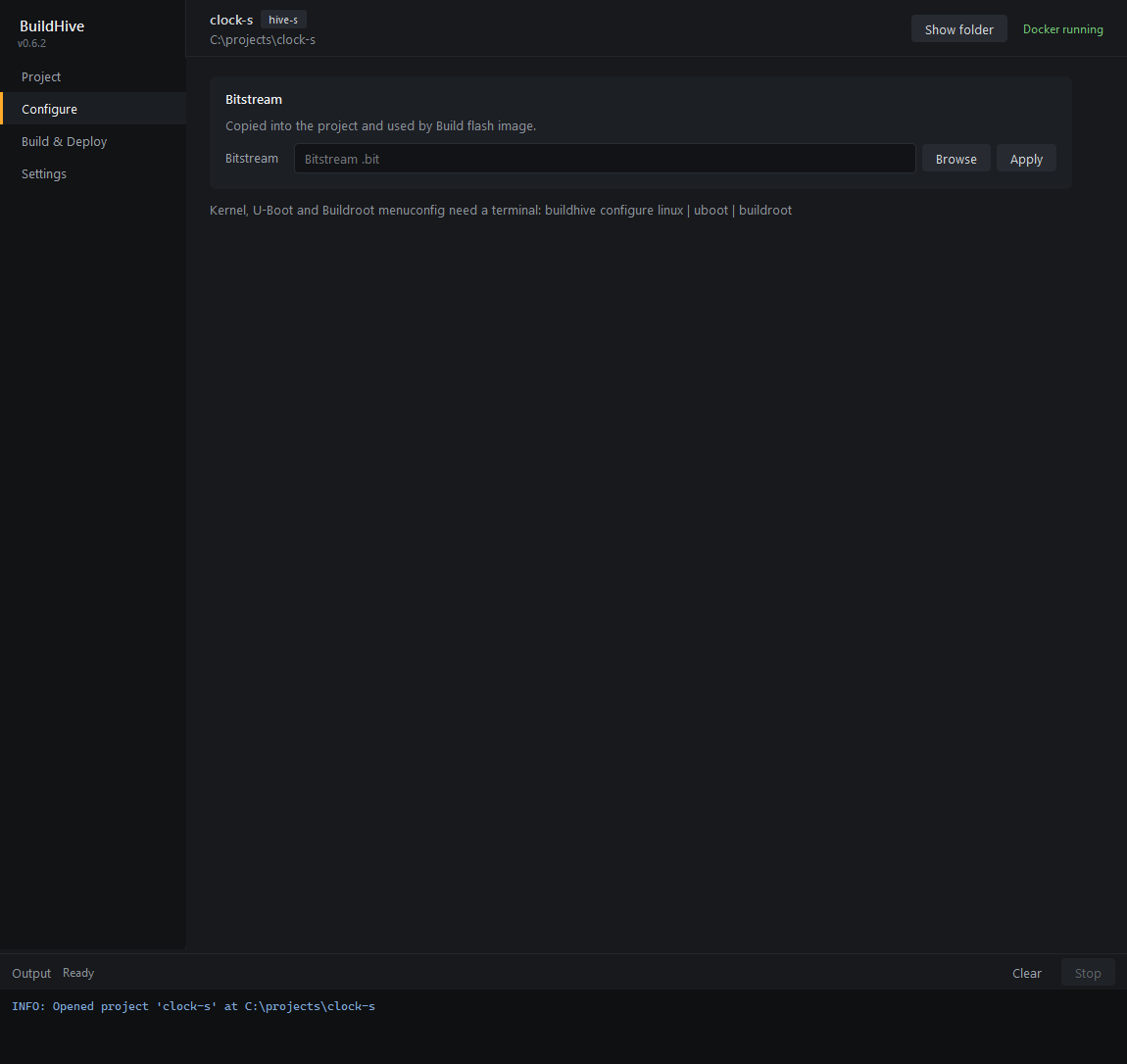
Bitstream: configure bitstream -f <file>, copied into the project and used by Build flash image.
app
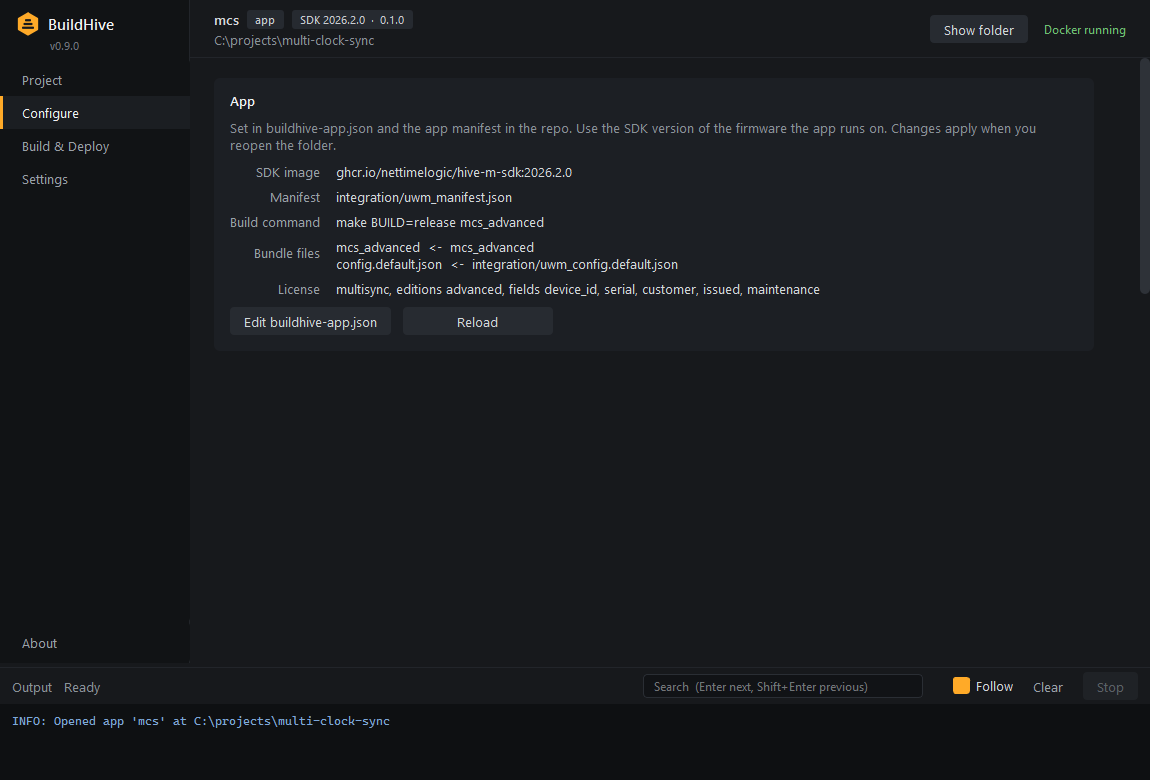
Read-only summary of buildhive-app.json: SDK image, manifest, build command, bundle files, license fields. Edit buildhive-app.json opens the file in the default editor. Reload reads it again. Schema: apps.md.
Build & Deploy
Builds run with -v so the container output shows in the panel. Output files land in images/.
hive-m
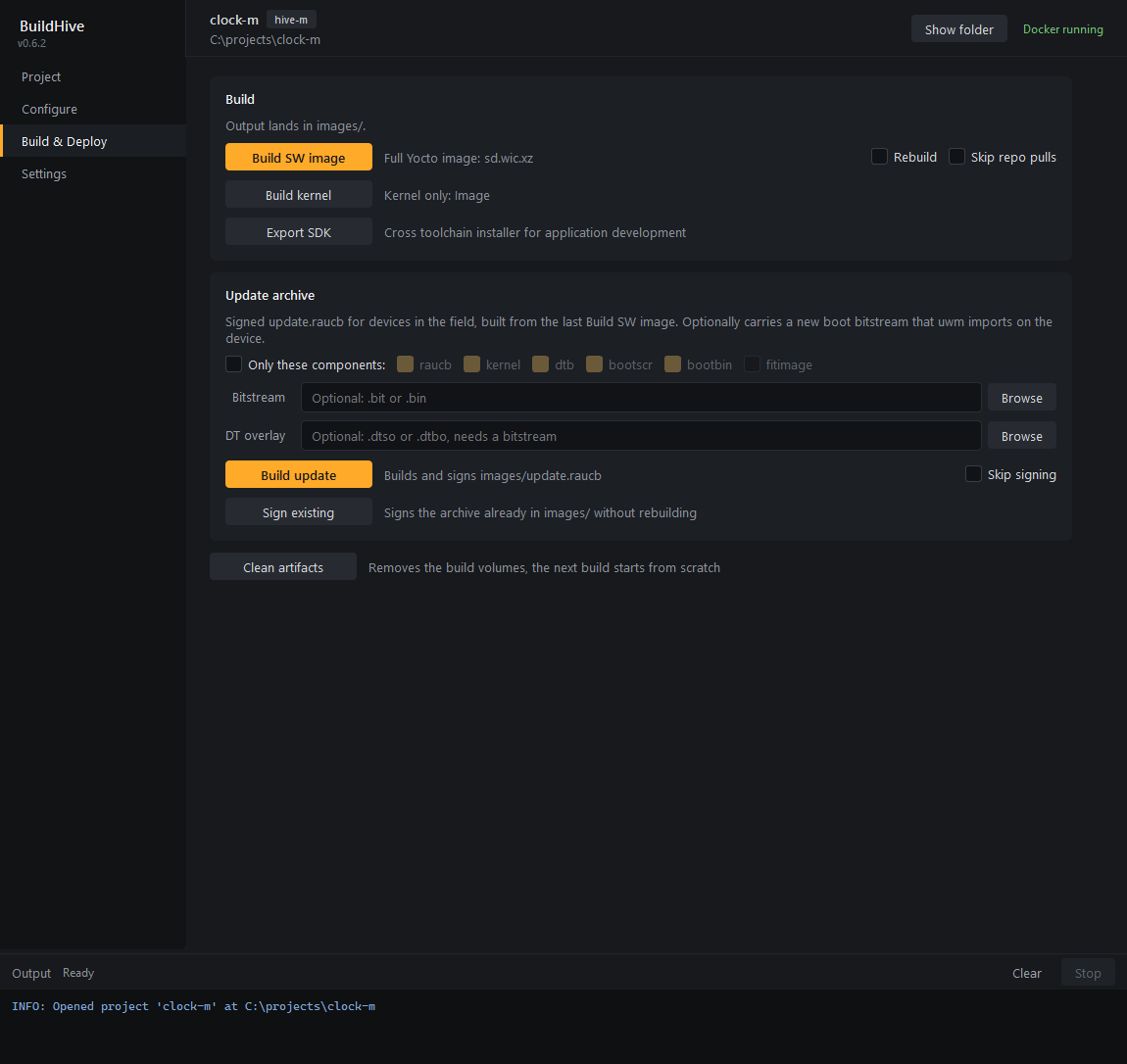
Build
| Button | Command | Options |
|---|---|---|
| Build SW image | build sw -v | Rebuild adds --rebuild (clean the build volumes first). Skip repo pulls adds --no-update (no repo sync, no git pull of the cloned repositories). |
| Build kernel | build kernel -v | Kernel Image only. |
| Export SDK | export sw -v | Cross toolchain installer for application development, see hive-m.md. |
Update archive. Builds images/update.raucb from the last Build SW image for devices in the field, see updates.md.
| Element | Command / flag |
|---|---|
| Only these components | --include <list> with the checked components. Unchecked: default set (everything except fitimage). |
| Bitstream | --bitstream <file>, .bit or .bin. Imported by uwm on the device and installed as the boot bitstream. |
| DT overlay | --dtbo <file>, .dtso or .dtbo. Needs a bitstream. |
| Build update | build update -v with the flags above. |
| Skip signing | Adds --no-sign. |
| Sign existing | build update --sign-only -v, signs the archive already in images/. |
Signing needs the buildsign token from the secrets server or from Settings.
hive-s
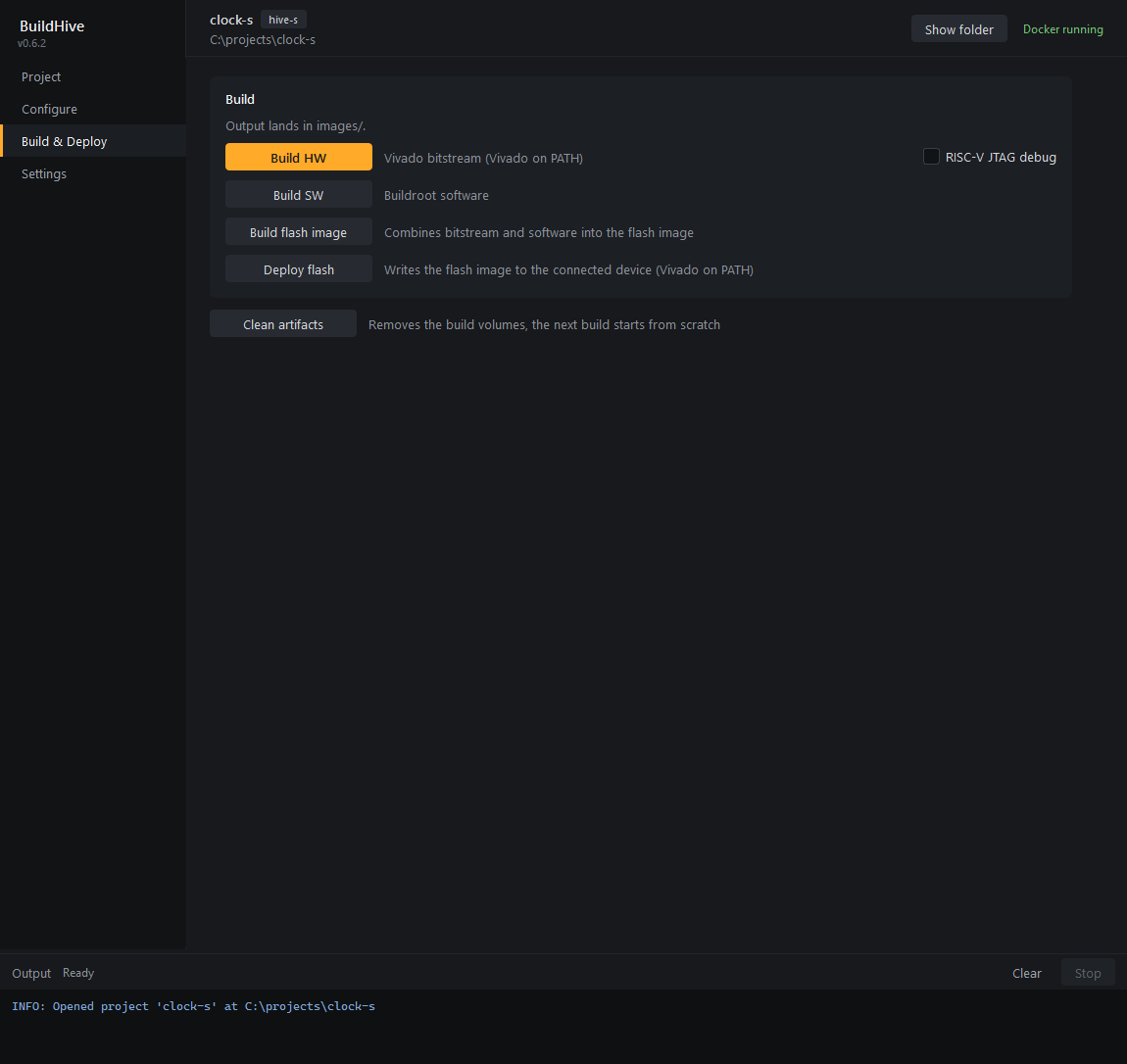
| Button | Command | Options |
|---|---|---|
| Build HW | build hw -v | Vivado on PATH. RISC-V JTAG debug adds --debug. |
| Build SW | build sw -v | Buildroot. |
| Build flash image | build flash -v | Needs the bitstream from Configure and built software. |
| Deploy flash | deploy flash -v | Vivado on PATH, device connected. |
app
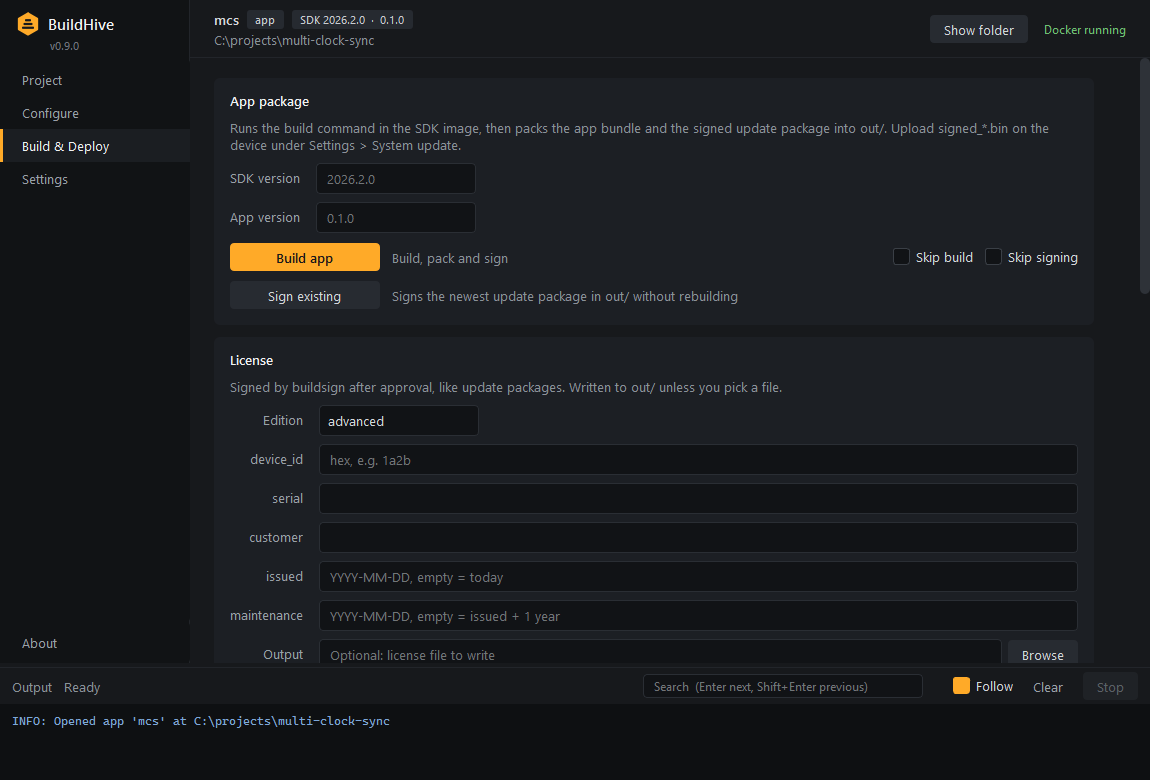
App package. Output in out/, see apps.md.
| Element | Command / flag |
|---|---|
| SDK version | --sdk <x.y.z>. Empty: sdk from the config. |
| App version | --version <v>. Empty: manifest version. |
| Build app | app build -v with the flags above. |
| Skip build | Adds --no-build. |
| Skip signing | Adds --no-sign. |
| Sign existing | app sign. |
License. Shown when the config has a license section. One input per license.fields entry. Empty inputs are not passed, so field defaults apply.
| Element | Command / flag |
|---|---|
| Create license | app license --edition <e> --<field> <value> ..., -o <file> when Output is set. |
| Verify | app license --verify <file>. |
Stop also stops the app build container (buildhive-app-<directory>).
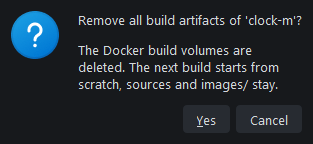
Clean artifacts
buildhive clean after confirmation. Deletes the Docker build volumes, so the next build starts from scratch. Sources, images/ and the sstate cache stay (clean --all for the sstate cache is CLI-only).
Settings
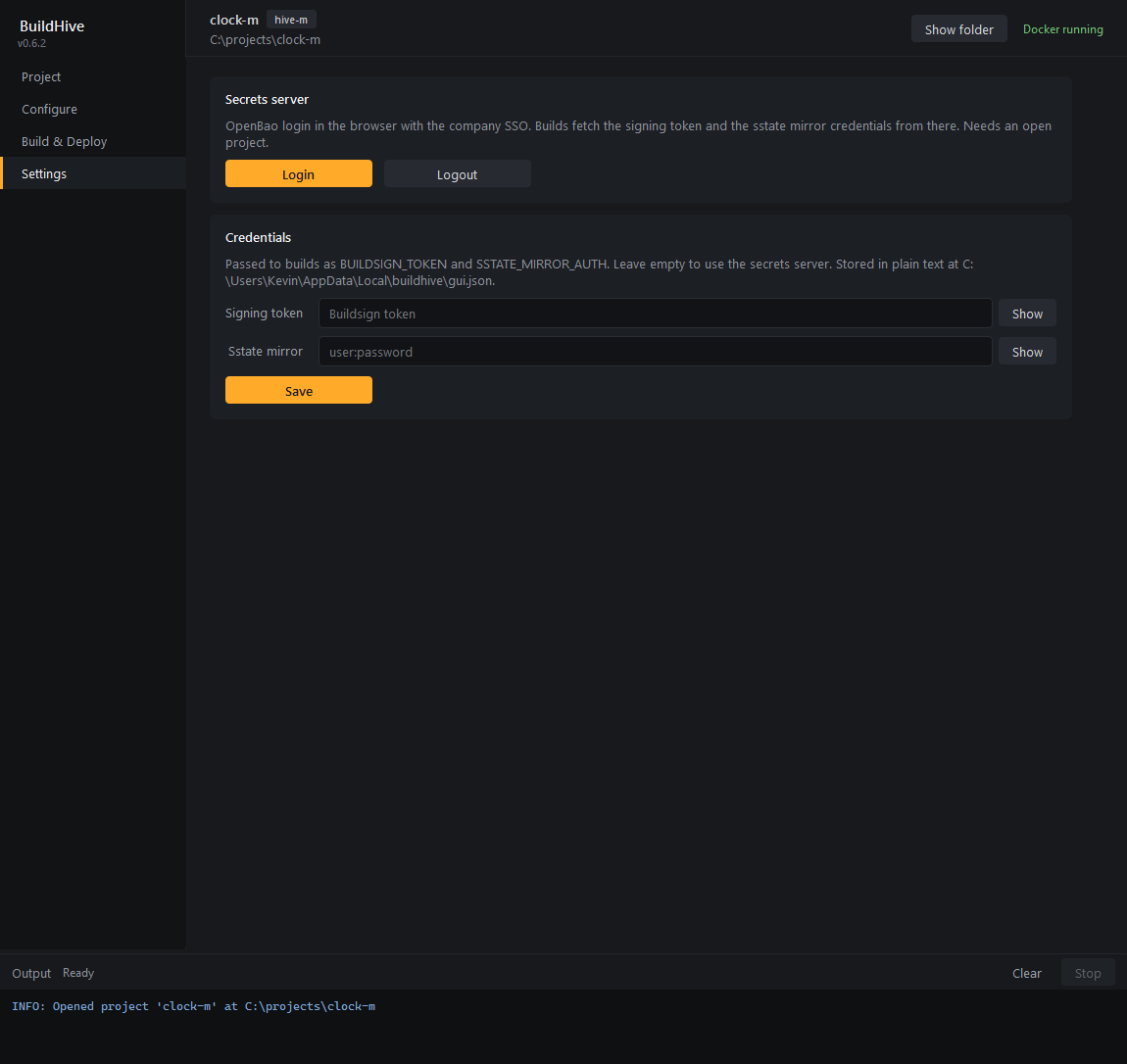
| Card | Content |
|---|---|
| Secrets server | Login runs buildhive login: browser login with the company SSO, token cached next to the GUI settings. Logout deletes the token. Needs an open project because the server URL comes from project.json. |
| BuildHive updates | Check for updates queries the GitHub releases now, logging in to the secrets server first if needed. Result goes to the output panel. |
| Credentials | Overrides for BUILDSIGN_TOKEN (signing) and SSTATE_MIRROR_AUTH (user:password). Passed to every command the GUI runs. Empty fields mean the command fetches them from the secrets server. Show toggles masking, Save writes both. |
About
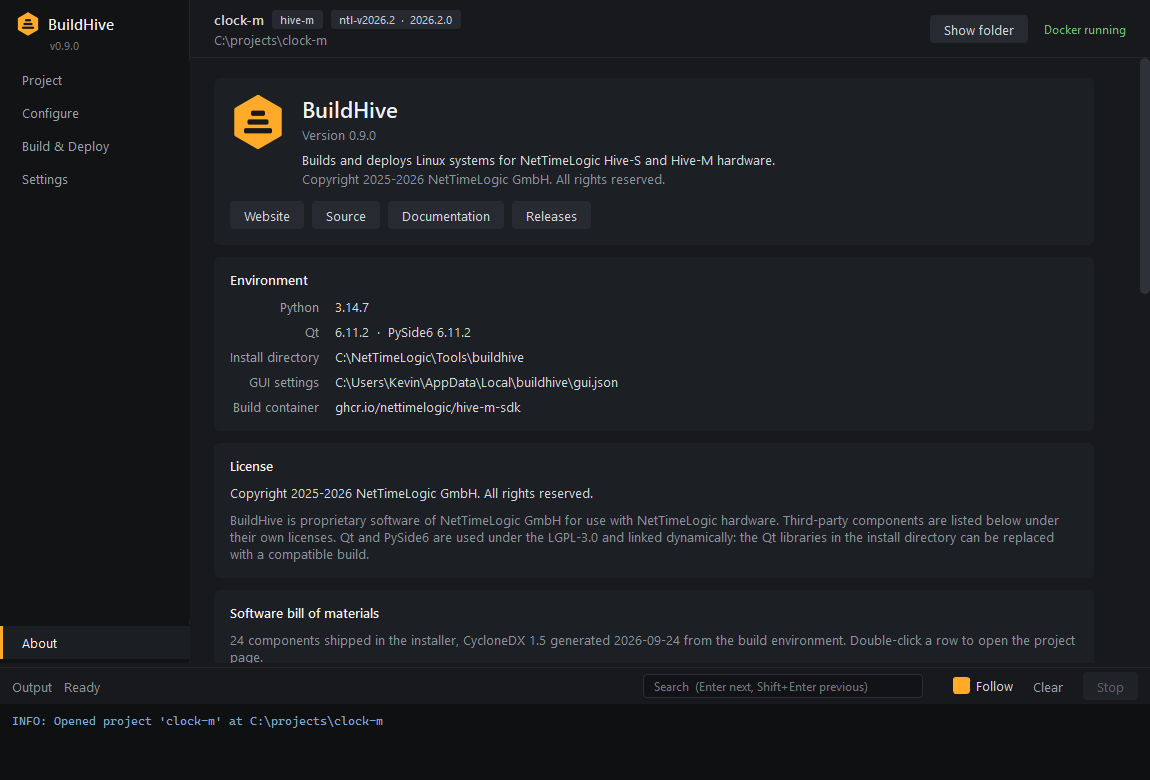
| Card | Content |
|---|---|
| Header | Version, links to website, source, documentation and releases. |
| Environment | Python and Qt versions, install directory, GUI settings file, build container image. |
| License | Copyright and the LGPL notice for Qt/PySide6. |
| Software bill of materials | Every Python package in the installer with version and license, read from assets/sbom.json (CycloneDX 1.5, written by tools/make_sbom.py during make build). Double-click opens the project page. |
BuildHive updates
Releases: NetTimeLogic/Tools, tags buildhive_v<x.y.z>, asset BuildHive_<x.y.z>_Setup.exe. The repo is private, so the GUI reads a GitHub token with Contents: read from the secrets server (buildhive/github, key GITHUB_TOKEN; GITHUB_TOKEN in the environment overrides it).
| Step | Behavior |
|---|---|
| Start, then every 3 h | Silent check with the cached secrets login. No login, offline or API error: nothing happens. Skipped while an update downloads. |
| Newer release | INFO: BuildHive x.y.z is available in the output, Update to x.y.z in the sidebar. |
| Update button | Confirmation, then the installer downloads to the temp dir and starts. BuildHive closes; the installer removes the old version and installs the new one (per user, no admin). Refused while a command runs. On Linux/macOS the button opens the releases page. |
| Errors | ERROR: Update failed: ... in the output, the button stays. |
| First start of a new version | What's new dialog with the CHANGELOG.md sections after the version of the last GUI start. Nothing on a fresh install or on a downgrade. |
Same from a terminal: buildhive upgrade (commands.md).
Settings file: gui.json in the OS config dir, %LOCALAPPDATA%\buildhive\ on Windows, ~/.config/buildhive/ on Linux. Plain text: the credential overrides, the recent project list and last_version (version of the last GUI start, for the What's new dialog).
Troubleshooting
| Symptom | Cause / fix |
|---|---|
Docker not running in the header | Start Docker Desktop. The header updates within 10 s. |
Command fails at once with Docker is not running or accessible | Same, the command checked Docker itself. |
Failed, exit N | Read the log, the last ERROR: line names the cause. Rerun from a terminal with the same command for an interactive session. |
| Nothing happens on double-click of the Start menu entry | The windowed exe has no console to print to. Run buildhive.exe gui from a terminal to see the error. |
layer.conf not found - update the project first | The project predates the meta-ntl-hive layer. Reopen it to get the update dialog. |
| Suggestions stay empty | No index yet, click Build index. Needs Docker and the first build environment setup (repo sync), a few minutes. |
| Project update shows conflicts every time | Merge markers still in a file. Resolve them, Re-check, Finish update. |
Implementation
| File | Content |
|---|---|
src/gui/app.py | QApplication, Fusion style, dark palette, stylesheet. |
src/gui/main_window.py | Sidebar (page list, About pinned at the bottom), header, page stack, output panel, run_cli(), Docker check, project open and update flow. |
src/gui/pages.py | Project, Configure, Build & Deploy and Settings pages. card() = titled section, ActionRow = button, description, options, FileRow = path field with Browse. |
src/gui/runner.py | CommandRunner thread: Popen of buildhive.exe (buildhive on Linux/macOS) next to the GUI exe (or main.py in a checkout), CREATE_NO_WINDOW, credentials via environment. DockerCheck thread. |
src/gui/update.py | Project update dialog, calls Project.update() and finish_update() in-process. |
src/gui/app_update.py | UpdateCheck and UpdateInstall threads around src/selfupdate.py, see BuildHive updates. |
src/gui/settings.py | gui.json load/save. |
src/gui/whats_new.py | What's new dialog, text from src/changelog.py. |
src/gui/about.py | About page, renders assets/sbom.json. |
src/gui/assets.py | Path to assets/ (checkout or PyInstaller bundle), logo pixmap. |
src/gui/style.py | Qt stylesheet, accent #ffaa28. |
tools/gui_screenshots.py | Renders the screenshots on this page into docs/images/gui/. |
buildhive.spec produces two exes from one analysis: buildhive.exe (console) and buildhive-gui.exe (console=False). Both run main.py; without arguments it starts the GUI, which spawns the console exe for commands. The windowed exe has no stdout or stderr, so nothing on the GUI path may exit on a failed print or on a missing Docker daemon: state.connect() runs only on the CLI path, stop_container() is a no-op without a connection.
Project configuration
Files in the project root
| File | Purpose |
|---|---|
project.json | Project configuration (schema below). Never touched by template updates. |
.buildhive_manifest.json | SHA-256 per template file; drives change detection on template updates. |
.buildhive_baseline/ | Pristine copies of text template files; base for 3-way merges. |
project.json is loaded from the current working directory only (no upward search). A directory counts as a project if project.json exists, parses as a JSON object and has a name key. Optional fields with value null are omitted on save (exclude_none).
Common fields (both templates)
| Field | Type | Default | Meaning |
|---|---|---|---|
id | string | generated | UUID hex, set on first load. Names the per-project Docker volumes/containers. |
name | string | - | Project name. Letters, digits, -, _; max 128 chars. |
template | string | - | hive-s or hive-m. Selects model and command set. |
release | string | ntl-v2026.1 | Template release the project is bound to (src/templates/<template>/<release>/), format ntl-v<year>.<n>. Set at create -r, changed with configure project --release. |
version | string | from template | Firmware build x.y.z within the release (2026.1.N). Exported as HIVE_VERSION for update archives, default SDK image tag. Set with configure project --version. |
buildhive_version | string | tool version | Tool that last wrote the project. A newer value than the running tool refuses the project; otherwise restamped silently. Template updates are triggered by changed template files, not by this field (see development.md). |
Git object used below: { "url": string, "branch": string }.
Hive-S schema
{
    "name": "...",
    "template": "hive-s",
    "sw": {
        "buildroot": { "url": "...", "branch": "..." },
        "uwm":       { "url": "...", "branch": "..." }
    },
    "hw": {
        "args": "--cpu-count=1 --with-rvc",
        "debug_args": "--ntl-debug --with-privileged-debug --hardware-breakpoints 4"
    },
    "flash": {
        "opensbi.bin": { "src": "0x...", "dst": "0x..." }
    }
}
| Field | Meaning |
|---|---|
sw.buildroot | Buildroot repo, cloned in the SW container, built with ntl_defconfig. |
sw.uwm | UWM repo (private, SSH). Built before Buildroot; loader copied into the rootfs overlay. |
hw.args | Arguments for the LiteX SoC generator (make.py). |
hw.debug_args | Appended to args with build hw --debug. |
flash | Map of image filename → {src, dst} hex address strings (parsed base-0). src = flash offset, dst = RAM load address (optional; e.g. uwm.xz has none). Consumed by build flash / info flash. Empty map is fatal at build. |
Hive-M schema
{
    "name": "...",
    "template": "hive-m",
    "secrets": {
        "url": "https://secrets.ntl.dev",
        "role": "dev"
    },
    "sw": {
        "yocto_manifests": { "url": "...", "branch": "..." },
        "clone": {
            "uwm":     { "url": "...", "branch": "master" },
            "udm":     { "url": "...", "branch": "master" },
            "drivers": { "url": "...", "branch": "master" }
        },
        "buildsign": {
            "url": "https://sign.ntl.dev/api",
            "public_key": "<base64 Ed25519 key>"
        },
        "secure_boot": false,
        "sstate_mirror": {
            "url": "https://sstate.ntl.dev",
            "hashserv": "wss://hashserv.ntl.dev"
        }
    }
}
| Field | Type/Default | Meaning |
|---|---|---|
secrets | optional | OpenBao server holding build secrets. url: API base. role: OIDC auth role (default dev). mount: KV v2 mount (default buildhive). Secrets read: <mount>/mirror key SSTATE_MIRROR_AUTH, <mount>/users/<login email>/<sw.buildsign.secret> then <mount>/<sw.buildsign.secret>, key BUILDSIGN_TOKEN. Lookup order per secret: env var of the same name, BAO_TOKEN env (CI), cached OIDC token, browser login (buildhive login). Server errors degrade: warning and mirror off, signing fatal. Without a secrets block only the env vars are used. |
sw.yocto_manifests | Git | repo init -u <url> -b <branch> on first container run. |
sw.clone | dict of Git, optional | Extra repos, cloned/pulled in parallel into sources/<name> and mounted at /custom_sources/<name>. Yocto recipes fetch uwm/udm from there (SRCREV=${AUTOREV}). --no-update skips the pull. |
sw.buildsign | optional | Signing server for update archives. url: API base. public_key: pinned base64 Ed25519 key (32 bytes) used to verify signatures locally; if unset, verification is skipped with a warning. secret: KV path under the secrets mount holding key BUILDSIGN_TOKEN (default buildsign). Lookup: users/<login email>/<secret> (personal token) first, then <secret> (shared). Without a buildsign block, build update requires --no-sign. |
sw.secure_boot | bool, false | true: requires keys/psk.pem (fatal otherwise), adds require .../secure-boot.conf to local.conf, switches the update archive to signed-FIT components. false: strips the require line. See secure-boot.md. |
sw.sstate_mirror | optional | Shared sstate/download mirror (see sstate-mirror/README.md). url: HTTPS base serving sstate-cache/ and downloads/; written to local.conf as SSTATE_MIRRORS, SOURCE_MIRROR_URL, INHERIT += "own-mirrors" between # >>> / # <<< buildhive sstate mirror markers on every run. hashserv: optional BB_HASHSERVE address (wss://host through the mirror proxy or host:8687 plain), sets BB_SIGNATURE_HANDLER = "OEEquivHash". Credentials user:password (basic auth) from SSTATE_MIRROR_AUTH env or the secrets server (secrets field); written to ~/.netrc inside the container, never to local.conf. Unavailable: warning, marker block removed, build uses the local cache only. |
Constants
| Constant | Value | Use |
|---|---|---|
VERSION | src/constants.py:1 | Tool version: installer, self-update, project.json buildhive_version, BUILDHIVE_VERSION in containers. Firmware and SDK versions come from project.json (release, version); build container images are tagged by the content hash of container/. |
LEGACY_RELEASE | ntl-v2026.1 | release assumed for projects written before the field existed. |
CONTAINER_USER / UID | ntl / 1000 | In-container user. |
WORK_DIR | /work | Yocto work tree, backed by ntl_buildhive_sw_<id>. |
SSTATE_DIR | /mnt/ntl_sstate | Shared sstate/download cache, backed by ntl_buildhive_sstate. |
Hive-S internals
LiteX/VexRiscv RISC-V soft-SoC on Artix-7. Buildroot rootfs, UWM firmware, single SPI flash image.
Project layout
| Path | Content |
|---|---|
project.json | Config: repos, SoC args, flash mapping. |
container/ | Dockerfile (RISC-V toolchain, LiteX pinned to tag 2025.04, bun), entrypoint. |
hw/ | LiteX SoC generator: make.py, soc_linux.py, vhdl/, xci/ (AXI clock converter IP). |
buildroot/ | BR2_EXTERNAL tree: configs/ntl_defconfig, board/hive-s/ (kernel config, post-image), patches/ (LiteX/LiteEth/LiteSPI/VexRiscv kernel patches, vexriscv-aes ssl patches), rootfs_overlay/ (motd, S99uwm.sh, /opt/ntl env + CA + uwm-loader). |
images/ | Build outputs + bitstream.bin. Never touched by template updates. |
tools/ | Vivado/OpenOCD flash scripts (flash_device.tcl, FTDI/Arty configs, bscan-spi bitstream). |
ip/ | Generated IP cores (output of build hw). |
Docker volumes: ntl_buildhive_hw_<name>_<id> and ntl_buildhive_sw_<name>_<id>. Host mounts: images/, hw/ (ro, HW container), buildroot/ (ro, SW container).
build hw
- HW container: pulls LiteX + VexRiscv sources, runs
./make.py <hw.args>- generates gateware sources and the device tree (rv32.dtb). - Rewrites paths in the generated
aionyx_hive_s.tclfrom container to host paths. - Host:
vivado -mode batch -source aionyx_hive_s.tclbuilds the IP cores, copied toip/.
Bitstream generation itself is manual in Vivado; import the result with buildhive configure bitstream -f <file> (→ images/bitstream.bin).
build sw
SW container, two stages:
- UWM - clone
sw.uwmintosources/uwm,make out/hive-s_full_tls→images/uwm.xz+uwm-loader; loader also copied intobuildroot/rootfs_overlay/opt/ntl. - Buildroot - clone
sw.buildroot,make ntl_defconfig(BR2_EXTERNAL=/buildroot),make -j→images/:Image.lzma,rootfs.cpio.xz,u-boot.bin,u-boot.dtb,opensbi.bin,rv32.dtb.
Flash image
build flash runs on the host, no Docker:
- Each
flashmapping entry is wrapped as.fbi: 4-byte length + 4-byte CRC32 + data. mapping_table.binholds the sorted (src, dst) address pairs.images/flash.binlayout: bitstream at offset 0, each component atsrc − 0x01000000, mapping table at0x3F0000.
At boot the SoC firmware walks the mapping table and copies each blob from its flash src to its RAM dst. Entries without dst (e.g. uwm.xz) stay in flash. info flash prints the table and the assembled layout.
deploy flash
vivado -mode gui -source tools/flash_device.tcl - programs the SPI flash over JTAG. Prompts for device selection if several are connected.
Hive-M internals
Xilinx ZynqMP, Yocto build (aionyx-image-minimal), RAUC A/B rootfs, uwm updater.
Project layout
| Path | Content |
|---|---|
project.json | Config: yocto manifests, clone repos, buildsign, secure_boot. |
container/ | Dockerfile: Ubuntu 24.04 Yocto host, repo tool, user ntl (uid 1000). |
images/ | system.xsa input + build outputs (sd.wic, Image, update archives). |
sources/sdt/ | System Device Tree (zynqmp*.dtsi, dt-bindings/), input to gen-machine-conf. Bitstream from configure xsa/configure bitstream lands here. |
sources/<repo> | Clones from sw.clone (uwm, udm, drivers). |
sw/meta-ntl-hive/ | The NTL Yocto layer, copied into the build tree on every run. |
sdk/ | Dockerfile + examples for the SDK image (export sw --image). |
oot/<module>/ | Out-of-tree module build dirs (created by build module). |
keys/ | Secure-boot keys (after secure-boot keygen, gitignored). |
Docker volumes
| Volume | Mount | Scope |
|---|---|---|
ntl_buildhive_sw_<name>_<id> | /work (.repo, build/) | per project |
ntl_buildhive_sstate | /mnt/ntl_sstate (sstate-cache/, downloads/) | shared across all hive-m projects; removed only by clean --all |
kdevsrc volume | /kernel-devsrc | per project, filled by build kernel-devsrc |
Bind mounts: sw/ → /sw (ro), sources/sdt → /custom_sources/sdt, keys/ → /keys (ro, if present), each clone repo → /custom_sources/<name>.
Init script
src/scripts/hive-m/init.sh, sourced by every hive-m command script (src/scripts/hive-m/*.sh, mounted at /opt/buildhive). Parameters arrive as BUILDHIVE_* container environment, built by get_init_env() in src/commands/hive_m/common/__init__.py:
- Exports
HIVE_VERSION(project.jsonversion, the firmware build) andBUILDHIVE_VERSION(tool version) viaBB_ENV_PASSTHROUGH_ADDITIONS. Update/migration archives takeHIVE_VERSION. - First run:
repo init -u <yocto_manifests.url> -b <branch>. Thenrepo sync -j$(nproc) --no-tags --optimized-fetch --no-clone-bundle, skipped with--no-update(container envBUILDHIVE_NO_UPDATE=1). source edf-init-build-env.- GUI builds (
BUILDHIVE_PROGRESS=json): installsbb/ui/buildhive.pyand setsBITBAKE_UI=buildhive, see gui.md. Terminal builds with-vget a pseudo-TTY (docker run -t) so knotty draws its progress bars. - Reconciles
conf/bblayers.confwith layers on disk (removes stale, adds missing). Sublayers such asmeta-openembedded/meta-oestay only while the meta-aionyxbblayers.conf.samplelists them. The file is replaced only when its content differs. - First run only (no
meta-ntl-hiveinbblayers.confyet): setsSSTATE_DIR/DL_DIRinlocal.conf, runsgen-machine-conf parse-sdt --hw-description /custom_sources/sdt --machine-name zynqmp-ntl-hive-m-sdt, creates+addsmeta-ntl-hive, setsMACHINE ??= ntl-hive-m. - Every run: re-copies
/sw/meta-ntl-hive/*into../sources/meta-ntl-hive/with--preserve=timestamps- layer edits in the project take effect on the next build, unchanged recipes stay in the parse cache. local.confis edited in a temp copy and installed only when the content changed:- the
secure-boot.confrequire line persw.secure_boot, - the
# >>> buildhive sstate mirrorblock persw.sstate_mirror; credentials fromSSTATE_MIRROR_AUTHenv or the secrets server, written to~/.netrc. Mirror misses fall back to the localntl_buildhive_sstatecache and a normal build, - the
# >>> buildhive rust pinblock:PREFERRED_VERSIONofrust-bin-crossandcargo-bin-crossset to<major>.<minor>.%fromchannelin/custom_sources/*/rust-toolchain.toml(uwm, udm). One Rust builds all recipes, so the highest minor version wins and aWARNING:lists differing channels. The newest meta-rust-bin patch release of that minor version is used. No numeric channel: no pin, newest meta-rust-bin Rust, - the
# >>> buildhive rm_workblock:INHERIT += "rm_work"withRM_WORK_EXCLUDE += "${PREFERRED_PROVIDER_virtual/kernel} aionyx-image-minimal". Work dirs are deleted after packaging (tmp/shrinks several times), sodevshell/tmp/workinspection only works for the excluded recipes;kernel-devsrcandexport sdk(busybox from the imagerootfs/) keep working.
- the
Why the content checks: bitbake's parse cache records the mtime of every conf file and layer file. A rewritten local.conf or bblayers.conf, even with identical content, reparses all recipes, once per multiconfig (three on hive-m: default, fsbl, pmu). With unchanged files the cache loads in seconds. -v prints buildhive: <seconds>s <step> after repo sync, build env, layer sync, config (container env BUILDHIVE_TIMING=1).
Build scripts call bh_own /custom_sources, which runs chown -R only when a file is not owned by the build user. The build container image is tagged with the content hash of container/ and rebuilt only when that tag is missing (docker rmi <tag> forces a rebuild).
Repos in sw.clone are pulled in parallel before the container starts; --no-update skips this too.
meta-ntl-hive layer
conf/layer.conf: priority 7, compatible scarthgap (ntl-v2026.1) or wrynose (ntl-v2026.2), depends on aionyx-hive. IMAGE_INSTALL:append adds extra packages to the image (template: ptp4l-config); edit with buildhive packages add|remove or the GUI Configure page, see commands.md.
| Group | Content |
|---|---|
classes | ntl-drivers.bbclass: copies /custom_sources/drivers into drivers/staging/ntl and enables all CONFIG_NTL_* as modules (files/ntl-drivers/ntl_drivers.cfg). Every kernel recipe inherits it. |
recipes-apps | uwm (Rust server + loader, systemd uwm-loader.service), udm, ptp4l + configs, phc2sys-sync (systemd service syncing system clock from PHC, device set via /etc/default/phc2sys), sw-conf. uwm/udm fetch from /custom_sources/* with SRCREV=${AUTOREV}. |
recipes-bsp | device-tree bbappend (FIT pubkey injection), u-boot bbappends + boot script. |
recipes-core | base-files, update bundles (updates.md), image bbappend, legacy migration, persistent-data, rauc config, systemd-conf. |
recipes-devtools | bun-native, mdbook-native (uwm frontend/docs), wic fix. |
recipes-kernel | hive-kernel.inc: config fragments in hive-kernel/ and inherit ntl-drivers, required by the linux-xlnx bbappend and by linux-ntl_6.18.bb. linux-ntl is kernel.org 6.18.58 with the configfs overlay patch and the device key / authenticated FPGA load patch. Select it with PREFERRED_PROVIDER_virtual/kernel = "linux-ntl". |
recipes-security | hive-ca, hive-jwt-secret. |
wic/rauc-zynqmp.wks | Disk layout (below). |
conf/machine/ntl-hive-m.conf requires the SDT-generated machine and backs /etc, /opt/ntl, /usr/lib/firmware overlays with /data.
Serial console lock
recipes-bsp/u-boot/u-boot-xlnx/console.cfg + patch 0002-configs-zynqmp-restrict-stored-env-*. Contract consumed by uwm (docs/src/security/serial-console.md in the uwm repo).
| Layer | Mechanism |
|---|---|
| U-Boot prompt | CONFIG_AUTOBOOT_KEYED + CONFIG_AUTOBOOT_ENCRYPTION: autoboot stops only on the password whose salted SHA256 is CONFIG_AUTOBOOT_STOP_STR_SHA256 (salt:hash). Hash lives in the signed u-boot binary, not in the env. |
| Prompt on/off | bootdelay in uboot.env (/boot, fw_setenv): 2 = password prompt, -2 = boot straight through. preboot maps -1 to 2; -1 would otherwise drop to the shell without a password check. |
| Stored env | CONFIG_ENV_WRITEABLE_LIST: uboot.env may only override bootdelay, BOOT_ORDER, BOOT_A_LEFT, BOOT_B_LEFT (CFG_ENV_FLAGS_LIST_STATIC). bootcmd, preboot, bootstopkeysha256 always come from the default env. Add new persisted vars to the list or u-boot silently drops them. |
| Linux login | serial-getty@ttyPS0.service (from SERIAL_CONSOLES), enable symlink in the /etc overlay. systemctl disable --now / enable --now by uwm. |
FSBL, PMUFW, ATF and U-Boot still print on UART0. Output only, no input path. JTAG not covered.
New password:
SALT=$(openssl rand -hex 4); printf '%s%s' "$SALT" "$PASSWORD" | sha256sum | awk -v s="$SALT" '{print s":"$1}'
Put the result in CONFIG_AUTOBOOT_STOP_STR_SHA256, rebuild u-boot. At the prompt type the password (no echo) during the delay.
SDK image
export sw --image wraps the populate_sdk installer into a standalone container for application developers: no Yocto tree, no buildhive.
| Item | Value |
|---|---|
| Image | ghcr.io/nettimelogic/hive-m-sdk:<version> (+ latest), linux/amd64 only (Yocto SDKMACHINE default) |
| Base | ubuntu:24.04 + build-essential (kernel HOSTCC), git, kmod, pkg-config, python3. cmake/ninja/ctest/qemu come from the SDK. |
| SDK | installer bind-mounted at build (RUN --mount), -y -d /opt/ntl-sdk; nativesdk locale-archive, non-aarch64 qemu-system-*/qemu-* and their firmware removed |
| Env | /etc/profile.d/ntl-sdk.sh sources environment-setup-* and sets CMAKE_CROSSCOMPILING_EMULATOR; pulled in by the entrypoint, /etc/bash.bashrc and login shells (docker run, docker exec, GitHub Actions bash -l) |
| qemu | qemu-aarch64 user-mode from nativesdk-qemu-xilinx; ntl-run <binary> wrapper, ctest transparent, QEMU_LD_PREFIX set so direct execution works on hosts with aarch64 binfmt_misc (Docker Desktop). System emulation uses Ubuntu qemu-system-arm (has virtfs/9p, the Xilinx build does not); Xilinx qemu-system-* and firmware removed. |
| User | ntl (uid 1000, passwordless sudo), WORKDIR /src |
| Kernel | kernel-devsrc in $SDKTARGETSYSROOT/usr/src/kernel, scripts prepare modules_prepare run at image build |
| Examples | /opt/ntl-sdk/examples/ (hello: C, CMake, Makefile; hello-module: out-of-tree kernel module) |
| modtest | ntl-modtest [-d overlay.dtso] [-r regs.txt] [-k] [-v] <module.ko>...: boots /opt/ntl-sdk/Image (copied from images/Image) in qemu-system-aarch64 -M virt -m 512M, initramfs = modtest/init (C, PID 1) + ld-linux + libc from the sysroot. Exit 0 on MODTEST: PASS. |
| shell | ntl-shell [-d overlay] [-r regs] [-m mod.ko]... [dir]: interactive busybox shell on the same kernel and mock. Base initramfs (/opt/ntl-sdk/busybox, copied from the image rootfs by export sw since target-sdk-provides-dummy keeps shells out of the SDK sysroot; usr/lib/*.so*, linuxptp, ntl-reg) cached in ~/.cache/ntl-shell, session archive (init script, overlay, regs, modules, /src copy) appended, one gzip stream, rootfstype=ramfs (tmpfs rootfs hits ENOSPC while unpacking). /src over 9p and eth0 via user networking when .config has 9P_FS/VIRTIO_NET. |
| PHC mock | ntl-shell -p <base>: ntl-mockphc daemon in the guest serving the ntl_phc register protocol (modtest/ntl-mockphc.c, header comment has the map): done bit permanent, time regs ticking from CLOCK_MONOTONIC + offset, settime/adjtime/adjfine command bits consumed. Makes phc_ctl, phc2sys, ptp4l usable without hardware. |
| HW mock | Kernel booted with mem=448M: 0x5c000000..0x5fffffff is guest RAM outside the kernel map, so ioremap and /dev/mem work on it. init writes regs.txt values there, applies the overlay via /sys/kernel/config/device-tree/overlays (target &{/}), loads modules, reports bound devices from /sys/module/<m>/drivers, dumps registers, unloads. Verified with ntl_phc (two cores probe, PTP clocks register). Registers are inert memory: no counters, no side effects. |
Build context is a temp dir under images/ holding only sdk/ and the installer (hardlinked when possible), so the wic files never reach the docker daemon. aionyx-image-minimal.bbappend sets TOOLCHAIN_HOST_TASK (+nativesdk-cmake/ninja/pkgconfig, makes the env script export CMAKE_TOOLCHAIN_FILE), TOOLCHAIN_TARGET_TASK (+kernel-devsrc) and SDKIMAGE_FEATURES = "dev-pkgs" (no dbg-pkgs/src-pkgs, ~1 GB less).
Kernel module: make -C $SDKTARGETSYSROOT/usr/src/kernel M=$PWD modules, see /opt/ntl-sdk/examples/hello-module. Module vermagic matches the kernel of the build the SDK came from; keep SDK version and firmware version paired. kernel-devsrc has no git metadata, so the Dockerfile derives the -g<sha>[-dirty] suffix from usr/lib/modules/<release> and passes it as LOCALVERSION to make prepare (exported in the profile too), failing the build on mismatch.
Usage:
docker run --rm -it -v "$PWD":/src ghcr.io/nettimelogic/hive-m-sdk:2026.1.0          # shell
docker run --rm -v "$PWD":/src ghcr.io/nettimelogic/hive-m-sdk:2026.1.0 make          # one-shot
docker run --rm -v "$PWD":/src ghcr.io/nettimelogic/hive-m-sdk:2026.1.0     sh -c 'cmake -B build -G Ninja && cmake --build build'
GitHub Actions (container: jobs skip the entrypoint, use a login shell):
jobs:
  build:
    runs-on: ubuntu-latest
    container: ghcr.io/nettimelogic/hive-m-sdk:2026.1.0
    defaults: { run: { shell: bash -leo pipefail {0} } }
    steps:
      - uses: actions/checkout@v4
      - run: cmake -B build -G Ninja && cmake --build build && ctest --test-dir build
Publish flow: buildhive export sw --push (or --no-build --push on an existing installer) after docker login ghcr.io. The tag defaults to project.json version, the firmware build the SDK was built from; --version overrides it.
recipes-kernel/linux/hive-kernel/qemu.cfg adds virtio-mmio/pci, virtio-net/blk/console, 9p and PCI_HOST_GENERIC to the Hive-M kernel. Inert on the board, lets ntl-shell share /src and network under -M virt; virtio-blk is the path to booting sd.wic in qemu later. export sw also copies rootfs/usr/bin/busybox to images/busybox for the guest shell.
Disk layout (rauc-zynqmp.wks)
| Partition | Size | Content |
|---|---|---|
p1 /boot | 512M FAT | BOOT.bin, kernel, dtb, boot.scr, uEnv.txt, uboot.env |
| p2 root_a | 2G | squashfs, RAUC slot A |
| p3 root_b | 2G | empty, RAUC slot B |
p4 /data | 2.5G ext4 | persistent overlay upper (/etc, /opt/ntl); never updated |
p5 /home | ext4 | growable (x-systemd.growfs) |
Cards with the older 512M /data are converted on the first boot of an updated rootfs. recipes-core/data-grow runs from the preinit before /data and /home are mounted:
- Stage
/dataand/homeasdata-grow.tar.zston/boot. - Rewrite the logical partitions:
/data2.5G,/homethe rest. - Recreate both file systems and restore the tar.
/boot/data-grow.state records the step. After a power cut the next boot continues there. If the tar does not fit on /boot (16 MiB reserve), the card keeps 512M and /boot/data-grow.skip holds the size of the failed attempt. The next attempt runs when the content is 10 % smaller.
Kernel development
build kernel-devsrc   ->  /kernel-devsrc volume: kernel source + build tree + env.sh
build module <name>   ->  oot/<name>/*.ko   (scaffolds Kbuild Makefile, builds against /kernel-devsrc)
build kernel-oot      ->  images/Image     (make -j Image modules, no bitbake)
shell --module <name> ->  bash with env.sh sourced, cwd oot/<name>
code                  ->  VS Code attached to dev container (/kernel-devsrc, /oot, /drivers)
env.sh sets ARCH, CROSS_COMPILE and the toolchain PATH. Module sources live in sources/drivers/staging/ntl/<name>/ (from the drivers clone repo). Re-run build kernel-devsrc after kernel config changes.
Update system (Hive-M)
Two layers: a RAUC bundle for the rootfs, wrapped in a uwm update archive that also carries boot artifacts.
RAUC bundle
recipes-core/bundles/update-bundle.bb: verity-format bundle, single slot rootfs = aionyx-image-minimal squashfs, signed with the RAUC key/cert from the layer (ntl-20260629.*). Output: update-bundle-ntl-hive-m.raucb.
Update archive
recipes-core/bundles/update-archive.bb packages the components in UPDATE_COMPONENTS plus a manifest.json into a flat hive-m-update-<version>.tar.gz applied by uwm.
| Component | Archive name | Destination |
|---|---|---|
raucb | update.raucb | RAUC install into the inactive slot |
kernel | Image | /boot/Image |
dtb | system.dtb | /boot/system.dtb |
bootscr | boot.scr | /boot/boot.scr |
bootbin | BOOT.bin | /boot/BOOT.bin |
fitimage | fitImage | /boot/fitImage (secure boot only) |
bitstream | source basename | /data/firmware/import/<name> (uwm import) |
dtbo | source basename (.dtso becomes .dtbo) | /data/firmware/import/<name> (uwm import) |
Default set: raucb kernel dtb bootscr bootbin; with SECURE_BOOT=1: raucb fitimage bootscr bootbin. Overridable per build via build update --include/--select (passed through as UPDATE_COMPONENTS).
Custom bitstream / DT overlay
build update --bitstream <file.bit|.bin> [--dtbo <file.dtso|.dtbo>] (or select the bitstream/dtbo component via --include/--select without the flag — a file-picker dialog opens) stages the files into images/update-fw/ (mounted at /images/update-fw); recipes-core/bundles/update-firmware.bb deploys them, compiling a .dtso with dtc (no -@, see sources/overlay/fpga-overlay.dtso). Both components map into /data/firmware/import/, where uwm's import_staged_boot_bitstream() picks them up on next start: validates, inserts as the boot bitstream (previous boot flag cleared by DB trigger), programs the FPGA; files are deleted only after a successful import.
Constraints (uwm side): one bitstream + one overlay per archive; an overlay without a bitstream is skipped (buildhive rejects --dtbo alone); shutdownReason must not be bitstreamUpdate (default systemReboot is correct — bitstreamUpdate programs the FPGA at shutdown before the import ran and skips cold-boot programming).
manifest.json: version, buildDate, fileMappings, optional minRequiredVersion, shutdownReason.
Version: the init script exports HIVE_VERSION from project.json version (configure project --version, or build update --version for one archive). UPDATE_VERSION in update-archive.bb defaults to HIVE_VERSION, then BUILDHIVE_VERSION (tool version, older layers), then 0.0.0 for manual bitbake outside buildhive.
Signing
The uwm updater only installs signed archives. build update signs automatically unless --no-sign; --sign-only signs an existing archive.
Flow (src/signing.py):
- Requires
BUILDSIGN_TOKEN(env var, else secrets server, see configuration.md) and NTL VPN reachability to thebuildsign.urlserver. - SHA-256 of the archive is computed locally and POSTed to
/signing-requests- the artifact itself is never uploaded. Payload: hash, filename, version, size, comment, pinned public key (server refuses other key material). - Polls every 10 s until
signed/rejected(exit 2) / timeout (default 3600 s, exit 3). - Signature (Ed25519, 64 bytes) is verified locally against the pinned
sw.buildsign.public_keyover"UWM-UPDATE-v1" + sha256. No pinned key: verification skipped with a warning. - Output:
images/signed_hive-m-update-<version>.bin= 64-byte signature followed by the raw tar.gz.
Legacy migration (0.3.9 → RAUC layout)
build update --legacy-migration builds hive-m-migration-<version>.tar.gz via recipes-core/migration/legacy-migration-update.bb - an archive in the old uwm format (unsigned) containing: new Image, system.dtb, BOOT.bin, RAUC boot.scr, a migration boot script, the migration initramfs, the rootfs squashfs, a migration.sha256 manifest.
Sequence on device:
- Old uwm-loader writes the mapped files to
/boot, reboots. - Migration
boot.scrboots the migration initramfs (migration-image.bb: RAM-only cpio withmigration-init, sfdisk, mke2fs, dosfstools). - Initramfs repartitions the SD card into the RAUC layout (hive-m.md), installs slot A, reboots into the new system.
MIGRATION_VERSION defaults to HIVE_VERSION like UPDATE_VERSION.
UWM apps
buildhive builds uwm apps in their own repo. No Hive-M project is needed. The build runs in the SDK image of one firmware version (ghcr.io/nettimelogic/hive-m-sdk:<sdk>), so the binary links against the glibc and libraries of that firmware. App format and runtime contract: docs/src/deployment/apps.md in the uwm repo.
buildhive-app.json
At the repo root. buildhive app init writes a skeleton. With this file in the current directory, the app build, app sign and app license commands exist.
{
    "sdk": "2026.2.0",
    "manifest": "integration/uwm_manifest.json",
    "build": "make BUILD=release mcs_advanced",
    "files": {
        "mcs_advanced": "mcs_advanced",
        "config.default.json": "integration/uwm_config.default.json"
    },
    "out": "out",
    "secrets": { "url": "https://secrets.ntl.dev", "role": "dev" },
    "buildsign": { "url": "https://sign.ntl.dev/api", "public_key": "wLh+..." },
    "license": {
        "format": "1",
        "product": "multisync",
        "editions": ["advanced"],
        "public_key": null,
        "fields": [
            { "name": "device_id", "type": "hex" },
            { "name": "serial" },
            { "name": "customer" },
            { "name": "issued", "type": "date", "default": "today" },
            { "name": "maintenance", "type": "date", "default": "issued+1y", "not_before": "issued" }
        ]
    }
}
| Key | Meaning |
|---|---|
sdk | SDK image tag x.y.z. Use the firmware version the app runs on. |
manifest | uwm app manifest in the repo. Checked with the same rules as uwm at install time. Unknown fields fail. Copied into the bundle as manifest.json. |
build | Shell command, run with bash -c in /src (the repo) inside the SDK image. CC, CFLAGS, LDFLAGS and the sysroot come from the SDK environment. |
files | Bundle file name -> repo path after the build. Must contain the manifest exec, and defaultConfig, configSchema and configTemplate when set. |
out | Output directory, default out. Add it to .gitignore. |
secrets | Secrets server for BUILDSIGN_TOKEN, as in project.json. Default https://secrets.ntl.dev. |
buildsign | Signing server and pinned public key (base64, 32 bytes), as sw.buildsign in project.json. |
license | Optional. Enables app license. |
license keys:
| Key | Meaning |
|---|---|
format | Value of the format line, default 1. |
product | Value of the product line. |
editions | Allowed values of the edition line. |
public_key | Key the app verifies licenses with (base64, 32 bytes). null = buildsign.public_key. app build writes it as PEM to out/license_public.pem and sets LICENSE_PUBKEY to that path in the build container. The app does not need its own copy of the key. |
fields | App fields in file order. type: text (default, not empty, no control characters), date (YYYY-MM-DD), hex (lower case, 0x removed). default: used when the option is not given. For dates: today, or ` |
Reserved field names: format, product, edition, key_id, signature, verify, output, sign_timeout.
Commands
buildhive app init
| Flag | Default | Description |
|---|---|---|
--manifest | uwm_manifest.json | Manifest path written to the config. |
--sdk | newest shipped hive-m template version | SDK version. |
Takes secrets and buildsign from the newest hive-m template. Fails if buildhive-app.json exists.
buildhive app build
| Flag | Default | Description |
|---|---|---|
--sdk | sdk | SDK version for this build only. |
--version | manifest version | App version written into the bundled manifest and the package. |
--no-build | off | Skip build, pack the existing files. |
--no-sign | off | Skip signing. uwm does not install unsigned packages. |
--sign-timeout | 3600 | Seconds to wait for the approval. |
-v, --verbose | off | Show the build output. Without it, the last 15 lines are shown on failure. |
Pulls the SDK image if it is not local. A failed pull needs docker login ghcr.io, or build the image in a Hive-M project with buildhive export sw --image --version <sdk>. On Linux the container runs with your uid and gid.
Writes to out/:
| File | Content |
|---|---|
<name>-app-<version>.tar.gz | App bundle: manifest.json + files. exec mode 0755, the rest 0644, owner 0:0. At most 512 MiB. |
<name>-update-<version>.tar.gz | Update package: manifest.json (version, buildDate, restartRequired: false, fileMappings: [{src: <bundle>, dest: "app"}]) + bundle. |
signed_<name>-update-<version>.bin | Signature (64 bytes) + update package. Upload under Settings > System update. |
buildhive app sign
Signs the newest *-update-*.tar.gz in out/. --sign-timeout as above. Signing flow and token: updates.md.
buildhive app license
| Flag | Description |
|---|---|
--edition | Edition. Default when editions has one entry. |
--<field> | One option per license.fields entry, _ written as - (--device-id). |
-o, --output | License file. Default out/<product>_<device_id>.lic, out/<product>.lic without a device_id field. Existing files are not overwritten. |
--verify FILE | Verify instead of create. Given --<field> values must match. |
--sign-timeout | Seconds to wait for the approval. |
Sends sha256 of the payload to buildsign with purpose: license and the license file name. After approval it checks the signature against license.public_key, then writes the file.
License format
format=1
product=multisync
edition=advanced
device_id=1234
serial=12345678
customer=test
issued=2026-11-09
maintenance=2027-11-09
key_id=01c67b9470364240
signature=<base64, 64 bytes>
- Payload: every byte before the
signature=line, UTF-8,\nline ends. - Line order:
format,product,edition,license.fieldsin config order,key_id. key_id: first 16 hex digits of sha256 over the raw 32-byte public key.- Signature: Ed25519 over
"NTL-LICENSE-v1" || sha256(payload). Update packages use"UWM-UPDATE-v1", so one signature is never valid for the other.
App side check:
- Split at
signature=. Base64-decode the signature. - Verify Ed25519 over
"NTL-LICENSE-v1"followed by the 32-byte sha256 of the payload. - Check
format,product,edition,key_idand the app fields, e.g.device_idagainst the FPGA ID.
buildsign must support purpose: license. A server without it signs with the update prefix. app license then fails with does not support 'license' signing requests yet and writes no file.
Makefiles in the SDK
The SDK exports CC, CFLAGS and LDFLAGS. A Makefile with CFLAGS ?= -Wall -Werror ... then skips its own flags. Use CFLAGS += ... for flags the build needs. Libraries the app links, e.g. -lcrypto, must be in the SDK sysroot and in the firmware image.
Secure boot (Hive-M)
Full chain: eFUSE PPK hash → RSA-signed BOOT.bin (FSBL, PMUFW, ATF, u-boot, dtb via bootgen) → signed FIT (kernel + dtb) verified by u-boot → RAUC-signed rootfs → buildsign-signed update archives.
Detailed device-side documentation: sw/SECURE_BOOT.md in a hive-m project (template: src/templates/hive-m/sw/SECURE_BOOT.md).
Setup
buildhive secure-boot keygen        # generate keys/ (once)
# set "secure_boot": true in project.json (sw section)
buildhive build sw
buildhive secure-boot ppk-hash      # -> images/ppk0_hash.txt for eFUSE provisioning
Keys (keys/, gitignored)
| File | Type | Use |
|---|---|---|
psk.pem | RSA-4096 | Primary secret key; PPK hash burned into eFUSEs. |
ssk.pem | RSA-4096 | Secondary secret key; signs BOOT.bin partitions. |
fit.key / fit.crt | RSA-2048, 30-year self-signed cert | FIT image signing; pubkey injected into u-boot control dtb. |
keygen --force overwrites - devices fused to the old PSK become unbootable.
Effect of sw.secure_boot: true
- Build fails if
keys/psk.pemis missing. require .../meta-ntl-hive/conf/secure-boot.confadded tolocal.conf. That conf setsSECURE_BOOT=1, the bootgen BIF (bh_auth_enableso signed images still boot unfused silicon; per-partition RSA authentication; bitstream deliberately unauthenticated),kernel-fitimage,UBOOT_SIGN_ENABLE=1,FIT_SIGN_ALG=rsa2048.device-tree.bbappendinjects the FIT public key into u-boot's control dtb withrequired="conf"- u-boot rejects unsigned FITs.- Update archive component set switches to
raucb fitimage bootscr bootbin(signed FIT replaces raw Image/dtb).
sw.secure_boot: false strips the require line from local.conf on the next run.
eFUSE provisioning
secure-boot ppk-hash runs bootgen (-efuseppkbits) against the deployed FSBL and the PSK → images/ppk0_hash.txt. Burn PPK0 hash + RSA_EN per the device documentation. After RSA_EN is fused, the device only boots BOOT.bin images signed with the matching PSK/SSK.
Development
Repo layout
| Path | Content |
|---|---|
src/main.py | Entry point; signal handlers stop running containers on Ctrl-C. |
src/commands/__init__.py | Command tree engine: nested dict (_help, _handler, _args) → argparse subparsers; unique-prefix abbreviation; version-mismatch dispatch. |
src/commands/common/ | create, gui, login/logout, upgrade, info project/secrets, configure project. |
src/commands/hive_s/, src/commands/hive_m/ | Template command sets. |
src/commands/app/ | app init (common), app build/sign/license (only with buildhive-app.json). |
src/commands/hive_m/common/__init__.py | Init script prepended to every hive-m container run. |
src/project.py | Project load/save/create, Docker image build, container/volume orchestration. |
src/state.py | Docker client plus the running container/process handles the Ctrl-C handler stops. |
src/common.py | Template copy, hash manifest, baseline, smart_update (3-way merge). |
src/models/ | Pydantic models for project.json, buildhive-app.json and the uwm app manifest. |
src/validate.py | Argument validation: project names, module names, file paths. |
src/log.py | Console output with the INFO:/WARNING:/ERROR:/OK: prefixes the GUI colors by. |
src/vault.py | Secrets server client: OIDC login, token cache, secret lookup. |
src/signing.py | Buildsign client. Purposes update and license, each with its own message prefix. |
src/uwm_app.py | App repos: SDK container build, bundle and update package, license payload and check. |
src/selfupdate.py | Release lookup on GitHub, installer download and start (upgrade, GUI update button). |
src/constants.py | VERSION, container constants, SECRETS_URL, SDK_IMAGE. |
src/changelog.py, CHANGELOG.md | Release notes, one ## <x.y.z> section per version. Bundled into the exe for the GUI What's new dialog. |
src/templates/ | default (shared skeleton), hive-s/<release>, hive-m/<release> project templates, one directory per shipped release (ntl-v2026.1). |
src/gui/ | PySide6 GUI, see gui.md. |
src/layerconf.py, src/recipe_index.py, src/scripts/recipe_indexer.py | IMAGE_INSTALL:append editing and the recipe index (packages commands). recipe_indexer.py is shipped as a data file and run with python3 inside the container. |
tests/ | pytest suite, no Docker needed: uv run pytest. |
src/scripts/ | Everything that runs inside the containers. Bind-mounted read-only at /opt/buildhive; a command is docker run ... bash /opt/buildhive/<script> with its parameters in a --env-file. lib.sh (errexit, bh_t/bh_install/bh_own), hive-m/init.sh (repo sync, build env, layer sync, local.conf blocks; reads BUILDHIVE_* from src/commands/hive_m/common/__init__.py get_init_env()), one hive-m/*.sh per command, hive-s/*.sh likewise. tests/test_scripts.py runs bash -n on all of them, shellcheck when installed. |
src/scripts/bitbake_ui.py | BitBake UI module (bb.ui.buildhive): knotty's TerminalFilter replaced by one that prints @@BH {json} progress lines. hive-m/init.sh copies it into bitbake/lib/bb/ui/ and sets BITBAKE_UI=buildhive when BUILDHIVE_PROGRESS=json (the GUI runner sets it). Parsed by src/gui/runner.py parse_progress(). |
tools/gui_screenshots.py | Renders docs/images/gui/*.png for the GUI docs. |
tools/make_icons.py | Renders assets/app.ico, assets/logo.png and the docs logo copies from assets/logo.svg. |
tools/make_sbom.py | Writes assets/sbom.json (CycloneDX 1.5) from the runtime packages installed in the venv. Runs in make build. |
tools/release_notes.py | Prints the CHANGELOG.md section of a release tag. Used by the release workflow. |
assets/ | Logo sources (logo.svg, logo-wordmark.svg) generated app.ico (exe, window and sidebar icon) and sbom.json (About page). |
docs/ | mdBook sources (book.toml, SUMMARY.md), published to GitHub Pages. |
pyproject.toml, uv.lock, .python-version | Dependencies (runtime in [project], tools in the dev group), lockfile, interpreter version for uv. |
buildhive.spec | PyInstaller spec, one analysis, two exes (buildhive.exe, buildhive-gui.exe). |
setup.iss | Inno Setup installer script. |
dist/ | PyInstaller output + BuildHive_Setup.exe. Not committed. |
Setup
uv manages the interpreter and the venv, the system Python is not used:
uv sync                      # installs Python 3.14 (.python-version) + .venv from uv.lock
uv run python src/main.py    # CLI / GUI from the checkout
uv run pytest
Dependencies live in pyproject.toml. uv add <pkg> / uv add --dev <pkg> update it and uv.lock; commit both. uv lock --upgrade bumps everything within the declared ranges. Without uv: uv export --format requirements-txt on a machine that has it.
Release process
Three versions, three owners:
| Version | Where | Meaning |
|---|---|---|
| Tool | VERSION, src/constants.py:1 | BuildHive release. setup.iss parses it (ISPP reads the first line), upgrade and the GUI compare it with the newest GitHub release tag, project.json buildhive_version records the tool that last wrote a project (an older tool refuses the project). Exported as BUILDHIVE_VERSION into hive-m containers for traceability. |
| Release | project.json release, e.g. ntl-v2026.1 | Template line the project is bound to: src/templates/<template>/<release>/. Same id as the yocto-manifests branch. Switch with configure project --release. |
| Firmware | project.json version, e.g. 2026.1.3 | Build within the release (<release number>.N). Exported as HIVE_VERSION; update-archive.bb / legacy-migration-update.bb in meta-aionyx-hive default UPDATE_VERSION / MIGRATION_VERSION from it (fallback BUILDHIVE_VERSION, then 0.0.0). Default SDK image tag. Set with configure project --version. |
A tool release therefore changes nothing in projects, firmware or SDK images unless template files changed (see Template update mechanism).
Adding a template release: cp -r src/templates/hive-m/ntl-v2026.1 src/templates/hive-m/ntl-v2026.2, set release and version in its project.json, update the branches. buildhive releases lists what a build ships; create defaults to the newest.
Release:
- Bump
VERSIONinsrc/constants.py. - Add a
## <x.y.z>section at the top ofCHANGELOG.md. Write it for users: what changed for them, not commit subjects. It is the GitHub release text and the GUIWhat's newdialog. - Commit, then tag and push:
git tag buildhive_v<x.y.z>,git push origin master buildhive_v<x.y.z>.
The tag starts .github/workflows/buildhive-release.yml:
| Job | Steps |
|---|---|
build (Windows, Linux x86_64 on Ubuntu 22.04, macOS arm64) | Tag must match VERSION. uv sync --locked, pytest, SBOM, PyInstaller. Windows: Inno Setup → BuildHive_<x.y.z>_Setup.exe. Linux/macOS: dist/buildhive/ as BuildHive_<x.y.z>_<platform>.tar.gz. |
release | tools/release_notes.py prints the CHANGELOG.md section (fails if missing), gh release create with all assets. |
Drafts and pre-releases are ignored by the update check. The asset name must match BuildHive_*_Setup.exe. Installers are release assets only, not committed. Local build without a release: make build, then compile setup.iss → dist/BuildHive_Setup.exe.
The installer (setup.iss) installs per user into %APPDATA%\NTL\BuildHive\bin, no admin. Same AppId on every version: Setup replaces the uninstall entry itself and deletes the old bin/ before copying, so an upgrade needs no separate uninstall. The upgrade command starts the downloaded installer two seconds after the CLI exits so bin/ is not in use. Uninstall removes the PATH entry and the app directory.
Documentation
docs/ is an mdBook. README.md is the front page: the workflow copies it to docs/README.md with docs/ stripped from its links (docs/README.md and docs/book/ are gitignored). Build locally:
sed 's#](docs/#](#g' README.md > docs/README.md
mdbook build docs      # or: mdbook serve docs
.github/workflows/buildhive-docs.yml builds on every push to master touching buildhive/docs/** or buildhive/README.md and deploys to GitHub Pages (repository setting Pages > Source: GitHub Actions). New pages go into docs/SUMMARY.md.
GUI screenshots: python tools/gui_screenshots.py on a desktop session, no Docker needed. Rerun after visible GUI changes.
Logo: edit assets/logo.svg / assets/logo-wordmark.svg, then python tools/make_icons.py (regenerates app.ico, logo.png, docs/images/logo*.svg, docs/theme/favicon.*).
Template update mechanism
State per project: .buildhive_manifest.json (SHA-256 of every template file at last sync) and .buildhive_baseline/ (pristine text-file copies).
Every command (and the GUI on open) compares the shipped template files of the project's release with the manifest (common.template_outdated). Any file with a different hash, or missing from the manifest, means "update available" and the user is prompted; a tool release without template changes prompts nothing, buildhive_version is just restamped. A project written by a newer tool is refused. Per file, three hashes decide (old manifest, new template, current disk):
| Situation | Action |
|---|---|
| Template unchanged, user changed | keep user file |
| Template changed, user unchanged | overwrite (backup .bak) |
| Both changed | 3-way merge via git merge-file against the baseline; conflicts get git-style markers |
| Unmergeable (binary / no baseline) | prompt: keep yours / take template |
| File removed from template | kept on disk, reported |
| New template file | copied in |
images/ and project.json are never touched. Unresolved conflicts keep their old manifest hash, so they are re-prompted on the next update. buildhive_version is bumped only after all conflicts are resolved - an aborted update prompts again.
If the project is newer than the tool, no files are modified; the tool asks you to upgrade BuildHive.
Template edits during development: hive-m copies sw/meta-ntl-hive into the Yocto build tree on every container start, so layer changes in a project take effect on the next build without any sync step. Changes to src/templates/ reach existing projects only through the update flow, which the changed hashes trigger on the next command.